

L’articolo è stato aggiunto alla lista dei desideri








LIBRO INGLESE
 E-mail
 Facebook
 LinkedIn
 Twitter
 WhatsApp
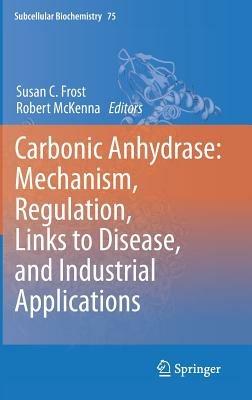
Carbonic Anhydrase: Mechanism, Regulation, Links to Disease, and Industrial Applications
(0)
Cliccando su “Conferma” dichiari che il contenuto da te inserito è conforme alle Condizioni Generali d’Uso del Sito ed alle Linee Guida sui Contenuti Vietati. Puoi rileggere e modificare e successivamente confermare il tuo contenuto. Tra poche ore lo troverai online (in caso contrario verifica la conformità del contenuto alle policy del Sito).
Grazie per la tua recensione!
Tra poche ore la vedrai online (in caso contrario verifica la conformità del testo alle nostre linee guida). Dopo la pubblicazione per te +4 punti 
204,10 €
+2040
punti 
Venditore: IBS
Articolo acquistabile con Carta del Docente

Articolo acquistabile con Carta Cultura Giovani e Carta del Merito

Articolo acquistabile con Carta della Cultura

Paga con Klarna in 3 rate senza interessi per ordini superiori a 39 €

Dati e Statistiche
 Salvato in 0 liste dei desideri
Salvato in 0 liste dei desideri
Carbonic Anhydrase: Mechanism, Regulation, Links to Disease, and Industrial Applications
Disponibilità in 2 settimane
204,10 €
204,10 €
Disponibilità in 2 settimane
Altre offerte vendute e spedite dai nostri venditori
Libri in Inglese
Carbonic Anhydrase: Mechanism, Regulation, Links to Disease, and Industrial Applications
Altri venditori
Prezzo e spese di spedizione

LIBRO INGLESE
Disponibilità in 2 settimane

Venduto e spedito da
IBS
Spedizione Gratis
204,10 €
Altri venditori
Prezzo e spese di spedizione
LIBRO INGLESE
Disponibilità in 2 settimane
Venduto e spedito da
IBS
Spedizione Gratis
204,10 €
Altri venditori
Prezzo e spese di spedizione

Tutti i formati ed edizioni
Promo attive (0)
The study of carbonic anhydrase has spanned multiple generations of scientists. Carbonic anhydrase was first discovered in 1932 by Meldrum and Roughton. Inhibition by sulfanilamide was shown in 1940 by Mann and Keilin. Even Hans Krebs contributed to early studies with a paper in 1948 showing the relationship of 25 different sulfonamides to CA inhibition. It was he who pointed out the importance of both the charged and uncharged character of these compounds for physiological experiments. The field of study that focuses on carbonic anhydrase (CA) has exploded in recent years with the identification of new families and isoforms. The CAs are metalloenzymes which are comprised of 5 structurally different families: the alpha, beta, gamma, and delta, and epsilon classes. The alpha class is found primarily in animals with several isoforms associated with human disease. The beta CAs are expressed primarily in plants and are the most divergent. The gamma CAs are the most ancient. These are structurally related to the beta CAs, but have a mechanism more similar to the alpha CAs. The delta CAs are found in marine algae and diflagellates. The epsilon class is found in prokaryotes in which it is part of the carboxysome shell perhaps supplying RuBisCO with CO2 for carbon fixation. With the excitement surrounding the discovery of disease-related CAs, scientists have redoubled their efforts to better understand structure-function relationships, to design high affinity, isotype-specific inhibitors, and to delineate signaling systems that play regulatory roles over expression and activity. We have designed the book to cover basic information of mechanism, structure, and function of the CA families. The authors included in this book bring to light the newest data with regard to the role of CA in physiology and pathology, across phylums, and in unique environmental niches.
Leggi di più
Leggi di meno
Curatore:
Editore:
Collana:
Subcellular Biochemistry
Anno:
2013
Rilegatura:
Hardback
Pagine:
430 p.
Testo in English
Dimensioni:
235 x 155 mm
EAN:
9789400773585

L'articolo è stato aggiunto al carrello
Informazioni e Contatti sulla Sicurezza dei Prodotti
Le schede prodotto sono aggiornate in conformità al Regolamento UE 988/2023. Laddove ci fossero taluni dati non disponibili per ragioni indipendenti da IBS, vi informiamo che stiamo compiendo ogni ragionevole sforzo per inserirli. Vi invitiamo a controllare periodicamente il sito www.ibs.it per eventuali novità e aggiornamenti.
Per le vendite di prodotti da terze parti, ciascun venditore si assume la piena e diretta responsabilità per la commercializzazione del prodotto e per la sua conformità al Regolamento UE 988/2023, nonché alle normative nazionali ed europee vigenti.
Per informazioni sulla sicurezza dei prodotti, contattare productsafetyibs@feltrinelli.it
L’articolo è stato aggiunto alla lista dei desideri
