

L’articolo è stato aggiunto alla lista dei desideri









LIBRO INGLESE
 E-mail
 Facebook
 LinkedIn
 Twitter
 WhatsApp
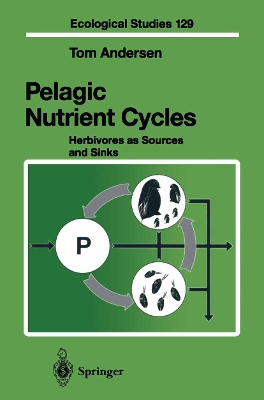
Pelagic Nutrient Cycles: Herbivores as Sources and Sinks
(0)
Cliccando su “Conferma” dichiari che il contenuto da te inserito è conforme alle Condizioni Generali d’Uso del Sito ed alle Linee Guida sui Contenuti Vietati. Puoi rileggere e modificare e successivamente confermare il tuo contenuto. Tra poche ore lo troverai online (in caso contrario verifica la conformità del contenuto alle policy del Sito).
Grazie per la tua recensione!
Tra poche ore la vedrai online (in caso contrario verifica la conformità del testo alle nostre linee guida). Dopo la pubblicazione per te +4 punti 
212,20 €
+2120
punti 
Venditore: IBS
Articolo acquistabile con Carta del Docente

Articolo acquistabile con Carta Cultura Giovani e Carta del Merito

Articolo acquistabile con Carta della Cultura

Paga con Klarna in 3 rate senza interessi per ordini superiori a 39 €

Dati e Statistiche
 Salvato in 0 liste dei desideri
Salvato in 0 liste dei desideri
Pelagic Nutrient Cycles: Herbivores as Sources and Sinks
Disponibilità in 2 settimane
212,20 €
212,20 €
Disponibilità in 2 settimane
Altre offerte vendute e spedite dai nostri venditori
Libri in Inglese
Pelagic Nutrient Cycles: Herbivores as Sources and Sinks
Altri venditori
Prezzo e spese di spedizione
LIBRO INGLESE
Disponibilità in 2 settimane

Venduto e spedito da
IBS
Spedizione Gratis
212,20 €
Altri venditori
Prezzo e spese di spedizione
LIBRO INGLESE
Disponibilità in 2 settimane
Venduto e spedito da
IBS
Spedizione Gratis
212,20 €
Altri venditori
Prezzo e spese di spedizione

Tutti i formati ed edizioni

Promo attive (0)
While ecology is one of the scientific disiplines that most clearly belongs to ''basic research", it also strives to serve as a predictive tool for management. Outstanding examples of predictive ecology are Vollenweider's models on the relationship between phosphorus load and water renewal time of lakes, and the resulting algal biomass. The needed few and easily accessible input parameters to very simple models provided a direct link from basic ecology to management, and today these models are key tools for managers worldwide to control lake eutrophication and algal blooms. The baseline of this success is the general relation between phosphorus concentration and phytoplankton biomass that is observed for most lakes. While these relationships are most frequently presented in log-log diagrams, the aquatic ecologist who replots these a linear scale may ask himself why, in spite of the overall correlation, there is still such a variability. It is possible to predict levels of algal biomass that may be synthesized at a given phosphorus load. Some lakes apparently offer optimal conditions for their phytoplankton communities, while others may support less than half the biomass at the same phosphorus load. There are limits to growth, however, and the predic tive outcome of phosphorus load decreases as the load increases. This holds in particular for the higher trophic levels like zooplankton and fish. With increased enrichment there are signs of decreased efficiency of energy trans fer between foodweb compartments.
Leggi di più
Leggi di meno
Autore:
Collana:
Ecological Studies
Anno:
2011
Rilegatura:
Paperback / softback
Pagine:
284 p.
Testo in English
Dimensioni:
235 x 155 mm
EAN:
9783642082795

L'articolo è stato aggiunto al carrello
Informazioni e Contatti sulla Sicurezza dei Prodotti
Le schede prodotto sono aggiornate in conformità al Regolamento UE 988/2023. Laddove ci fossero taluni dati non disponibili per ragioni indipendenti da IBS, vi informiamo che stiamo compiendo ogni ragionevole sforzo per inserirli. Vi invitiamo a controllare periodicamente il sito www.ibs.it per eventuali novità e aggiornamenti.
Per le vendite di prodotti da terze parti, ciascun venditore si assume la piena e diretta responsabilità per la commercializzazione del prodotto e per la sua conformità al Regolamento UE 988/2023, nonché alle normative nazionali ed europee vigenti.
Per informazioni sulla sicurezza dei prodotti, contattare productsafetyibs@feltrinelli.it
L’articolo è stato aggiunto alla lista dei desideri
