

L’articolo è stato aggiunto alla lista dei desideri









LIBRO INGLESE
 E-mail
 Facebook
 LinkedIn
 Twitter
 WhatsApp
Principles and Forms of Sociocultural Organization: Historical Contexts of Interaction
(0)
Cliccando su “Conferma” dichiari che il contenuto da te inserito è conforme alle Condizioni Generali d’Uso del Sito ed alle Linee Guida sui Contenuti Vietati. Puoi rileggere e modificare e successivamente confermare il tuo contenuto. Tra poche ore lo troverai online (in caso contrario verifica la conformità del contenuto alle policy del Sito).
Grazie per la tua recensione!
Tra poche ore la vedrai online (in caso contrario verifica la conformità del testo alle nostre linee guida). Dopo la pubblicazione per te +4 punti 
95,00 €

-5%
100,00 €
+950
punti
Venditore: IBS
Articolo acquistabile con Carta del Docente

Articolo acquistabile con Carta Cultura Giovani e Carta del Merito

Articolo acquistabile con Carta della Cultura

Paga con Klarna in 3 rate senza interessi per ordini superiori a 39 €

Dati e Statistiche
 Salvato in 0 liste dei desideri
Salvato in 0 liste dei desideri
Principles and Forms of Sociocultural Organization: Historical Contexts of Interaction
Disponibile in 5 gg lavorativi
95,00 €
-5%
100,00 €
95,00 €
100,00 €
-5%
Disponibile in 5 gg lavorativi
Altre offerte vendute e spedite dai nostri venditori

Libri in Inglese
Principles and Forms of Sociocultural Organization: Historical Contexts of Interaction
Altri venditori
Prezzo e spese di spedizione
LIBRO INGLESE
Disponibile in 5 gg lavorativi

Venduto e spedito da
IBS
Spedizione Gratis
-5%
100,00 €
95,00 €
Altri venditori
Prezzo e spese di spedizione
LIBRO INGLESE
Disponibile in 5 gg lavorativi
Venduto e spedito da
IBS
Spedizione Gratis
-5%
100,00 €
95,00 €
Altri venditori
Prezzo e spese di spedizione

Tutti i formati ed edizioni

Promo attive (0)
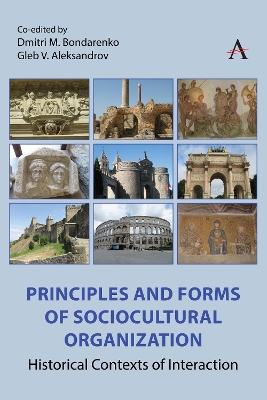
To show the non-linear nature of social evolution, it is crucially important to discuss cases from different cultural areas and different historical periods, including our time, as well as different levels of overall sociocultural complexity. This anthology includes chapters that explore case studies covering a wide range of societies of the Old and the New World ranging from ancient to modern contexts. Respectively, the chapters are based on different kinds of sources – archaeological, historical, anthropological (ethnographic), and sociological. This analysis of pre-modern and modern societies sheds valuable light on the variety of ways in which social institutions were developing through time and space and of how these institutions may have fostered social evolution. Therefore, this publication may enhance our understanding of social evolution at the world-system, regional, and local-culture levels via the integration of various kinds of evidence within a unified conceptual framework. Societies are systems composed of a great number of various social institutions. Societies change as a result of emergence, transformation, and interaction of institutions. As systems of social institutions, societies have a fundamental characteristic that can be called a “basic principle of societal organization.” The principle of organization a society embodies depends on the way its institutions are arranged with respect to one another. Two basic principles can be distinguished: heterarchical, at which institutions interact being unranked with respect to one another or can be ranked in different ways, and the opposite principle, homoarchical, at which institutions interact being rigidly ranked in the only way and have no or very limited potential for being unranked or ranked in other ways. Societies of the same level of overall cultural complexity and with the same basic principle of organization can take different specific forms, as alternativeness exists not only between but also within the heterarchical and homoarchical macrogroups of societies. The division of societies into predominantly heterarchical and homoarchical is a constant fact of human sociocultural history. The dichotomy of heterarchy and homoarchy has considerably determined the non-linear and alternative nature of the global sociocultural process. Transformations in the ways social institutions and their sets, societal subsystems, are ranked (homoarchically or heterarchically) on one hand and changes in the overall sociocultural complexity on the other are two different, largely unrelated processes. Homoarchy and heterarchy are not evolutionary lines: a society can pass from a predominantly heterarchical way of ranking institutions to predominantly homoarchical or vice versa, and can do it both with and without a change in level of complexity. At any level of overall cultural complexity, one can observe both heterarchical and homoarchical societies, because an equal level of complexity (which makes it possible to solve equally difficult problems societies face) can be achieved in various forms on essentially different (though intersecting in the history of many societies and regions) principles of societal organization.
Leggi di più
Leggi di meno
Curatore:
Editore:
Anno:
2026
Rilegatura:
Hardback
Pagine:
286 p.
Testo in English
Dimensioni:
229 x 153 mm
Peso:
555 gr.
EAN:
9781839995910

L'articolo è stato aggiunto al carrello
Informazioni e Contatti sulla Sicurezza dei Prodotti
Le schede prodotto sono aggiornate in conformità al Regolamento UE 988/2023. Laddove ci fossero taluni dati non disponibili per ragioni indipendenti da IBS, vi informiamo che stiamo compiendo ogni ragionevole sforzo per inserirli. Vi invitiamo a controllare periodicamente il sito www.ibs.it per eventuali novità e aggiornamenti.
Per le vendite di prodotti da terze parti, ciascun venditore si assume la piena e diretta responsabilità per la commercializzazione del prodotto e per la sua conformità al Regolamento UE 988/2023, nonché alle normative nazionali ed europee vigenti.
Per informazioni sulla sicurezza dei prodotti, contattare productsafetyibs@feltrinelli.it
L’articolo è stato aggiunto alla lista dei desideri
