

L’articolo è stato aggiunto alla lista dei desideri









LIBRO INGLESE
 E-mail
 Facebook
 LinkedIn
 Twitter
 WhatsApp
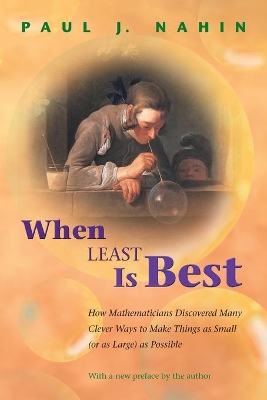
When Least Is Best: How Mathematicians Discovered Many Clever Ways to Make Things as Small (or as Large) as Possible
(0)
Cliccando su “Conferma” dichiari che il contenuto da te inserito è conforme alle Condizioni Generali d’Uso del Sito ed alle Linee Guida sui Contenuti Vietati. Puoi rileggere e modificare e successivamente confermare il tuo contenuto. Tra poche ore lo troverai online (in caso contrario verifica la conformità del contenuto alle policy del Sito).
Grazie per la tua recensione!
Tra poche ore la vedrai online (in caso contrario verifica la conformità del testo alle nostre linee guida). Dopo la pubblicazione per te +4 punti 
38,30 €
+380
punti 
Venditore: IBS
Articolo acquistabile con Carta del Docente

Articolo acquistabile con Carta Cultura Giovani e Carta del Merito

Articolo acquistabile con Carta della Cultura

Dati e Statistiche
 Salvato in 0 liste dei desideri
Salvato in 0 liste dei desideri
When Least Is Best: How Mathematicians Discovered Many Clever Ways to Make Things as Small (or as Large) as Possible
Disponibilità in 2 settimane
38,30 €
38,30 €
Disponibilità in 2 settimane
Altre offerte vendute e spedite dai nostri venditori

Libri in Inglese
When Least Is Best: How Mathematicians Discovered Many Clever Ways to Make Things as Small (or as Large) as Possible
Altri venditori
Prezzo e spese di spedizione
LIBRO INGLESE
Disponibilità in 2 settimane

Venduto e spedito da
IBS
Spedizione Gratis
38,30 €
Altri venditori
Prezzo e spese di spedizione
LIBRO INGLESE
Disponibilità in 2 settimane
Venduto e spedito da
IBS
Spedizione Gratis
38,30 €
Altri venditori
Prezzo e spese di spedizione

Tutti i formati ed edizioni

Promo attive (0)
What is the best way to photograph a speeding bullet? Why does light move through glass in the least amount of time possible? How can lost hikers find their way out of a forest? What will rainbows look like in the future? Why do soap bubbles have a shape that gives them the least area? By combining the mathematical history of extrema with contemporary examples, Paul J. Nahin answers these intriguing questions and more in this engaging and witty volume. He shows how life often works at the extremes--with values becoming as small (or as large) as possible--and how mathematicians over the centuries have struggled to calculate these problems of minima and maxima. From medieval writings to the development of modern calculus to the current field of optimization, Nahin tells the story of Dido's problem, Fermat and Descartes, Torricelli, Bishop Berkeley, Goldschmidt, and more. Along the way, he explores how to build the shortest bridge possible between two towns, how to shop for garbage bags, how to vary speed during a race, and how to make the perfect basketball shot. Written in a conversational tone and requiring only an early undergraduate level of mathematical knowledge, When Least Is Best is full of fascinating examples and ready-to-try-at-home experiments. This is the first book on optimization written for a wide audience, and math enthusiasts of all backgrounds will delight in its lively topics.
Leggi di più
Leggi di meno
Autore:
Editore:
Anno:
2007
Rilegatura:
Paperback / softback
Pagine:
392 p.
Testo in English
Dimensioni:
235 x 152 mm
Peso:
567 gr.
EAN:
9780691130521

L'articolo è stato aggiunto al carrello
Informazioni e Contatti sulla Sicurezza dei Prodotti
Le schede prodotto sono aggiornate in conformità al Regolamento UE 988/2023. Laddove ci fossero taluni dati non disponibili per ragioni indipendenti da IBS, vi informiamo che stiamo compiendo ogni ragionevole sforzo per inserirli. Vi invitiamo a controllare periodicamente il sito www.ibs.it per eventuali novità e aggiornamenti.
Per le vendite di prodotti da terze parti, ciascun venditore si assume la piena e diretta responsabilità per la commercializzazione del prodotto e per la sua conformità al Regolamento UE 988/2023, nonché alle normative nazionali ed europee vigenti.
Per informazioni sulla sicurezza dei prodotti, contattare productsafetyibs@feltrinelli.it
L’articolo è stato aggiunto alla lista dei desideri
