

L’articolo è stato aggiunto alla lista dei desideri










LIBRO INGLESE
 E-mail
 Facebook
 LinkedIn
 Twitter
 WhatsApp
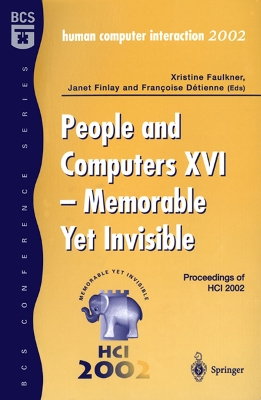
People and Computers XVI - Memorable Yet Invisible: Proceedings of HCI 2002
(0)
Cliccando su “Conferma” dichiari che il contenuto da te inserito è conforme alle Condizioni Generali d’Uso del Sito ed alle Linee Guida sui Contenuti Vietati. Puoi rileggere e modificare e successivamente confermare il tuo contenuto. Tra poche ore lo troverai online (in caso contrario verifica la conformità del contenuto alle policy del Sito).
Grazie per la tua recensione!
Tra poche ore la vedrai online (in caso contrario verifica la conformità del testo alle nostre linee guida). Dopo la pubblicazione per te +4 punti 

67,50 €
+680
punti 
Venditore: IBS
Articolo acquistabile con Carta del Docente

Articolo acquistabile con Carta Cultura Giovani e Carta del Merito

Articolo acquistabile con Carta della Cultura

Paga con Klarna in 3 rate senza interessi per ordini superiori a 39 €

Dati e Statistiche
 Salvato in 0 liste dei desideri
Salvato in 0 liste dei desideri
People and Computers XVI - Memorable Yet Invisible: Proceedings of HCI 2002
Disponibilità in 2 settimane
67,50 €
67,50 €
Disponibilità in 2 settimane
Altre offerte vendute e spedite dai nostri venditori
Libri in Inglese
People and Computers XVI - Memorable Yet Invisible: Proceedings of HCI 2002
Altri venditori
Prezzo e spese di spedizione
Nuovo
Disponibilità in 2 settimane

Venduto e spedito da
IBS
Spedizione Gratis
67,50 €
Altri venditori
Prezzo e spese di spedizione
Nuovo
Disponibilità in 2 settimane
Venduto e spedito da
IBS
Spedizione Gratis
67,50 €
Altri venditori
Prezzo e spese di spedizione

Tutti i formati ed edizioni

For the last 20 years the dominant form of user interface has been the Graphical User Interface (GUl) with direct manipulation. As software gets more complicated and more and more inexperienced users come into contact with computers, enticed by the World Wide Web and smaller mobile devices, new interface metaphors are required. The increasing complexity of software has introduced more options to the user. This seemingly increased control actually decreases control as the number of options and features available to them overwhelms the users and 'information overload' can occur (Lachman, 1997). Conversational anthropomorphic interfaces provide a possible alternative to the direct manipulation metaphor. The aim of this paper is to investigate users reactions and assumptions when interacting with anthropomorphic agents. Here we consider how the level of anthropomorphism exhibited by the character and the level of interaction affects these assumptions. We compared characters of different levels of anthropomorphic abstraction, from a very abstract character to a realistic yet not human character. As more software is released for general use with anthropomorphic interfaces there seems to be no consensus of what the characters should look like and what look is more suited for different applications. Some software and research opts for realistic looking characters (for example, Haptek Inc., see http://www.haptek.com). others opt for cartoon characters (Microsoft, 1999) others opt for floating heads (Dohi & Ishizuka, 1997; Takama & Ishizuka, 1998; Koda, 1996; Koda & Maes, 1996a; Koda & Maes, 1996b).
Leggi di più
Leggi di meno
Curatore:
Editore:
Anno:
2002
Rilegatura:
Paperback / softback
Pagine:
422 p.
Testo in English
Dimensioni:
235 x 155 mm
EAN:
9781852336592

L'articolo è stato aggiunto al carrello
Informazioni e Contatti sulla Sicurezza dei Prodotti
Le schede prodotto sono aggiornate in conformità al Regolamento UE 988/2023. Laddove ci fossero taluni dati non disponibili per ragioni indipendenti da IBS, vi informiamo che stiamo compiendo ogni ragionevole sforzo per inserirli. Vi invitiamo a controllare periodicamente il sito www.ibs.it per eventuali novità e aggiornamenti.
Per le vendite di prodotti da terze parti, ciascun venditore si assume la piena e diretta responsabilità per la commercializzazione del prodotto e per la sua conformità al Regolamento UE 988/2023, nonché alle normative nazionali ed europee vigenti.
Per informazioni sulla sicurezza dei prodotti, contattare productsafetyibs@feltrinelli.it
L’articolo è stato aggiunto alla lista dei desideri
