

L’articolo è stato aggiunto alla lista dei desideri








LIBRO INGLESE
 E-mail
 Facebook
 LinkedIn
 Twitter
 WhatsApp
Peripheral Auditory Mechanisms: Proceedings of a conference held at Boston University, Boston, MA, August 13–16, 1985
(0)
Cliccando su “Conferma” dichiari che il contenuto da te inserito è conforme alle Condizioni Generali d’Uso del Sito ed alle Linee Guida sui Contenuti Vietati. Puoi rileggere e modificare e successivamente confermare il tuo contenuto. Tra poche ore lo troverai online (in caso contrario verifica la conformità del contenuto alle policy del Sito).
Grazie per la tua recensione!
Tra poche ore la vedrai online (in caso contrario verifica la conformità del testo alle nostre linee guida). Dopo la pubblicazione per te +4 punti 
68,10 €
+680
punti 
Venditore: IBS
Articolo acquistabile con Carta del Docente

Articolo acquistabile con Carta Cultura Giovani e Carta del Merito

Articolo acquistabile con Carta della Cultura

Paga con Klarna in 3 rate senza interessi per ordini superiori a 39 €

Dati e Statistiche
 Salvato in 0 liste dei desideri
Salvato in 0 liste dei desideri
Peripheral Auditory Mechanisms: Proceedings of a conference held at Boston University, Boston, MA, August 13–16, 1985
Disponibilità in 2 settimane
68,10 €
68,10 €
Disponibilità in 2 settimane
Altre offerte vendute e spedite dai nostri venditori
Libri in Inglese
Peripheral Auditory Mechanisms: Proceedings of a conference held at Boston University, Boston, MA, August 13–16, 1985
Altri venditori
Prezzo e spese di spedizione
LIBRO INGLESE
Disponibilità in 2 settimane

Venduto e spedito da
IBS
Spedizione Gratis
68,10 €
Altri venditori
Prezzo e spese di spedizione
LIBRO INGLESE
Disponibilità in 2 settimane
Venduto e spedito da
IBS
Spedizione Gratis
68,10 €
Altri venditori
Prezzo e spese di spedizione

Tutti i formati ed edizioni
Promo attive (0)
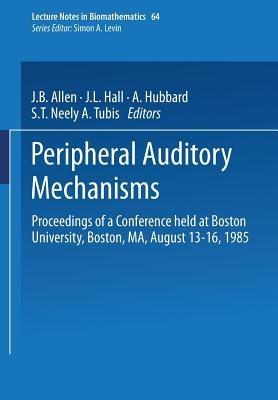
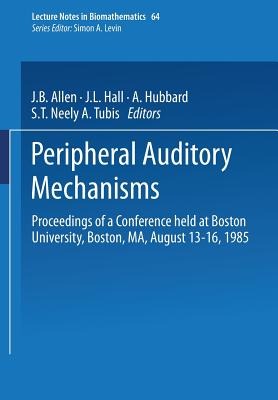
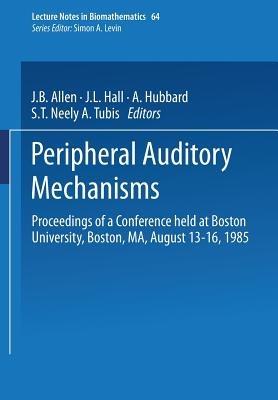
How weIl can we model experimental observations of the peripheral auditory system'? What theoretical predictions can we make that might be tested'? It was with these questions in mind that we organized the 1985 Mechanics of Hearing Workshop, to bring together auditory researchers to compare models with experimental observations. Tbe workshop forum was inspired by the very successful 1983 Mechanics of Hearing Workshop in Delft [1]. Boston University was chosen as the site of our meeting because of the Boston area's role as a center for hearing research in this country. We made a special effort at this meeting to attract students from around the world, because without students this field will not progress. Financial support for the workshop was provided in part by grant BNS- 8412878 from the National Science Foundation. Modeling is a traditional strategy in science and plays an important role in the scientific method. Models are the bridge between theory and experiment. Tbey test the assumptions made in experimental designs. They are built on experimental results, and they may be used to test hypotheses and predict experimental results. Tbe latter is the scientific method at its best. Cochlear function is very complicated. For this reason, models play animportant role. One goal of modeling is to gain understanding, but the necessary mathematical tools are often formidably complex. An ex am pie of this is found in cochlear macromechanics.
Leggi di più
Leggi di meno
Curatore:
Collana:
Lecture Notes in Biomathematics
Anno:
1986
Rilegatura:
Paperback / softback
Pagine:
402 p.
Testo in English
Dimensioni:
244 x 170 mm
EAN:
9783540160953

L'articolo è stato aggiunto al carrello
Informazioni e Contatti sulla Sicurezza dei Prodotti
Le schede prodotto sono aggiornate in conformità al Regolamento UE 988/2023. Laddove ci fossero taluni dati non disponibili per ragioni indipendenti da IBS, vi informiamo che stiamo compiendo ogni ragionevole sforzo per inserirli. Vi invitiamo a controllare periodicamente il sito www.ibs.it per eventuali novità e aggiornamenti.
Per le vendite di prodotti da terze parti, ciascun venditore si assume la piena e diretta responsabilità per la commercializzazione del prodotto e per la sua conformità al Regolamento UE 988/2023, nonché alle normative nazionali ed europee vigenti.
Per informazioni sulla sicurezza dei prodotti, contattare productsafetyibs@feltrinelli.it
L’articolo è stato aggiunto alla lista dei desideri
