

L’articolo è stato aggiunto alla lista dei desideri










EBOOK IN LINGUA STRANIERA
 E-mail
 Facebook
 LinkedIn
 Twitter
 WhatsApp
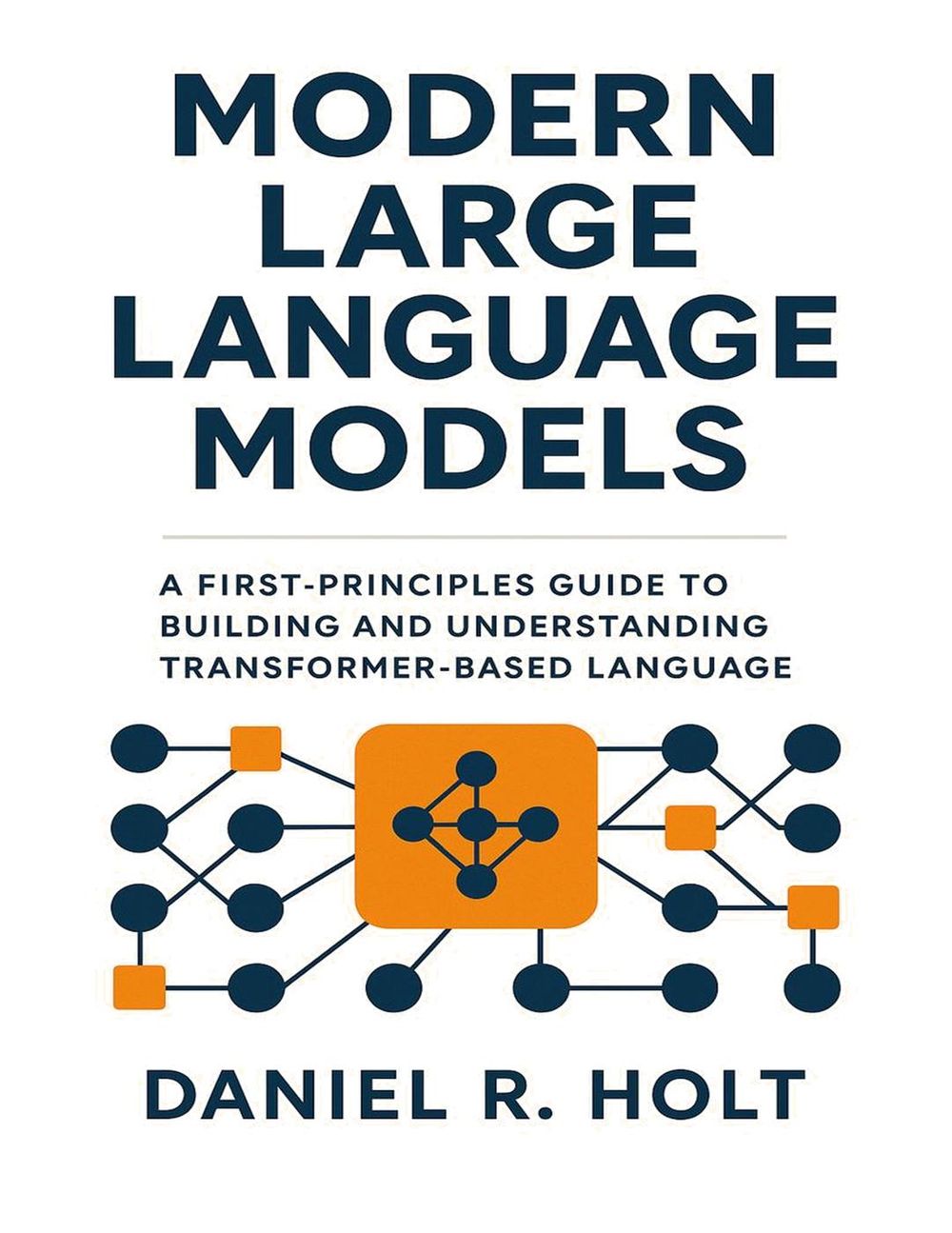
Modern Large Language Models: A First-Principles Guide to Building and Understanding Transformer-Based Language Models
(0)
Cliccando su “Conferma” dichiari che il contenuto da te inserito è conforme alle Condizioni Generali d’Uso del Sito ed alle Linee Guida sui Contenuti Vietati. Puoi rileggere e modificare e successivamente confermare il tuo contenuto. Tra poche ore lo troverai online (in caso contrario verifica la conformità del contenuto alle policy del Sito).
Grazie per la tua recensione!
Tra poche ore la vedrai online (in caso contrario verifica la conformità del testo alle nostre linee guida). Dopo la pubblicazione per te +4 punti 
8,99 €
+90
punti 
Venditore: IBS

Acquista online
Scaricabile subito
Articolo acquistabile con Carta del Docente

Articolo acquistabile con Carta Cultura Giovani e Carta del Merito

Articolo acquistabile con Carta della Cultura

Dati e Statistiche
 Salvato in 0 liste dei desideri
Salvato in 0 liste dei desideri
Modern Large Language Models: A First-Principles Guide to Building and Understanding Transformer-Based Language Models
Scaricabile subito
8,99 €
8,99 €
Scaricabile subito
Altre offerte vendute e spedite dai nostri venditori

Ebook in lingua straniera
Modern Large Language Models: A First-Principles Guide to Building and Understanding Transformer-Based Language Models
Altri venditori
Prezzo e spese di spedizione
EBOOK INGLESE
EPUB2 con DRMFREE
Scaricabile subito

Venduto e spedito da
IBS
Spedizione Gratis
8,99 €
Altri venditori
Prezzo e spese di spedizione
EBOOK INGLESE
EPUB2 con DRMFREE
Scaricabile subito
Venduto e spedito da
IBS
Spedizione Gratis
8,99 €
Altri venditori
Prezzo e spese di spedizione

Tutti i formati ed edizioni
Promo attive (0)
Modern Large Language Models: A First-Principles Guide to Building and Understanding Transformer-Based Language Models
Large language models now sit at the core of modern software systems. They power search, recommendation engines, coding assistants, conversational interfaces, and autonomous agents. Yet for many engineers and practitioners, these models remain opaque—understood through fragments of code, borrowed recipes, or surface-level explanations. This book was written to change that. Modern Large Language Models is a clear, systems-level guide to understanding how transformer-based language models actually work—starting from first principles and building upward toward complete, modern LLM systems. Rather than treating large language models as black boxes, this book explains the fundamental ideas that make them possible: probabilistic language modeling, vector representations, attention mechanisms, optimization, and architectural composition. Concepts are introduced gradually, with visual intuition and concrete reasoning before full implementations, allowing readers to develop understanding that transfers beyond any single framework or model version. The book takes you from the foundations of language modeling to the realities of training, fine-tuning, evaluation, and deployment. Along the way, it connects theory to practice, showing how design decisions shape model behavior, performance, and limitations. This is not a collection of shortcuts or prompt recipes. It is a guide for readers who want to reason about large language models as engineered systems—systems that can be analyzed, debugged, improved, and deployed with confidence. What You'll Learn • How language modeling works at a probabilistic level—and why it matters • How tokens, embeddings, and vector spaces encode meaning • How self-attention and transformer architectures operate internally • How complete GPT-style models are built from first principles • How training pipelines work, including optimization and scaling considerations • How fine-tuning, instruction tuning, and preference optimization fit together • How embeddings, retrieval, and RAG systems extend model capabilities • How modern LLM systems are evaluated, deployed, and monitored responsibly What Makes This Book Different Most books on large language models focus either on high-level descriptions or narrow implementation details. This book takes a first-principles, systems-oriented approach, emphasizing understanding over memorization and architecture over tools. The examples use PyTorch for clarity, but the ideas are framework-agnostic and designed to remain relevant as tooling and architectures evolve. Clean diagrams, structured explanations, and carefully reasoned trade-offs replace hype and jargon. Who This Book Is For This book is written for software engineers, data scientists, machine learning practitioners, researchers, and technically curious readers who want to move beyond surface familiarity with LLMs. You do not need to be an expert in machine learning to begin, but you should be comfortable with programming and willing to engage with ideas thoughtfully. Readers looking for quick tutorials or platform-specific recipes may want supplementary resources; readers seeking durable understanding will find this book invaluable. What This Book Is Not This book does not promise instant mastery, viral tricks, or platform-specific shortcuts. It does not focus on prompt engineering in isolation, nor does it attempt to catalog every model variant or benchmark. Instead, it focuses on what lasts: the principles that explain why large language models work—and how to think cle
Leggi di più
Leggi di meno
Autore:
Anno edizione:
2025
Editore:
Formato:
Lingua:
Inglese
Compatibilità:
Tutti i dispositivi (eccetto Kindle) Scopri di più
Layout:
Reflowable
EAN:
9798231865895
L'articolo è stato aggiunto al carrello
Formato:
Gli eBook venduti da IBS.it sono in formato ePub e possono essere protetti da Adobe DRM. In caso di download di un file protetto da DRM si otterrà un file in formato .acs, (Adobe Content Server Message), che dovrà essere aperto tramite Adobe Digital Editions e autorizzato tramite un account Adobe, prima di poter essere letto su pc o trasferito su dispositivi compatibili.
Cloud:
Gli eBook venduti da IBS.it sono sincronizzati automaticamente su tutti i client di lettura Kobo successivamente all’acquisto. Grazie al Cloud Kobo i progressi di lettura, le note, le evidenziazioni vengono salvati e sincronizzati automaticamente su tutti i dispositivi e le APP di lettura Kobo utilizzati per la lettura.
Clicca qui per sapere come scaricare gli ebook utilizzando un pc con sistema operativo Windows
L’articolo è stato aggiunto alla lista dei desideri
