

L’articolo è stato aggiunto alla lista dei desideri








LIBRO INGLESE
 E-mail
 Facebook
 LinkedIn
 Twitter
 WhatsApp
Aromaticity: Exploring Basic Chemical Concepts with the Quantum Theory of Atoms in Molecules
(0)
Cliccando su “Conferma” dichiari che il contenuto da te inserito è conforme alle Condizioni Generali d’Uso del Sito ed alle Linee Guida sui Contenuti Vietati. Puoi rileggere e modificare e successivamente confermare il tuo contenuto. Tra poche ore lo troverai online (in caso contrario verifica la conformità del contenuto alle policy del Sito).
Grazie per la tua recensione!
Tra poche ore la vedrai online (in caso contrario verifica la conformità del testo alle nostre linee guida). Dopo la pubblicazione per te +4 punti 
63,74 €
+640
punti 
Prezzo minimo ultimi 30 giorni: 60,55 €
Venditore: IBS
Articolo acquistabile con Carta del Docente

Articolo acquistabile con Carta Cultura Giovani e Carta del Merito

Articolo acquistabile con Carta della Cultura

Paga con Klarna in 3 rate senza interessi per ordini superiori a 39 €

Dati e Statistiche
 Salvato in 0 liste dei desideri
Salvato in 0 liste dei desideri
Aromaticity: Exploring Basic Chemical Concepts with the Quantum Theory of Atoms in Molecules
Attualmente non disponibile
63,74 €
63,74 €
Attualmente non disponibile
Altre offerte vendute e spedite dai nostri venditori
Libri in Inglese
Aromaticity: Exploring Basic Chemical Concepts with the Quantum Theory of Atoms in Molecules
Altri venditori
Prezzo e spese di spedizione
LIBRO INGLESE
Attualmente non disponibile

Venduto e spedito da
IBS
Spedizione Gratis
63,74 €
Altri venditori
Prezzo e spese di spedizione
LIBRO INGLESE
Attualmente non disponibile
Venduto e spedito da
IBS
Spedizione Gratis
63,74 €
Altri venditori
Prezzo e spese di spedizione

Tutti i formati ed edizioni
Promo attive (0)
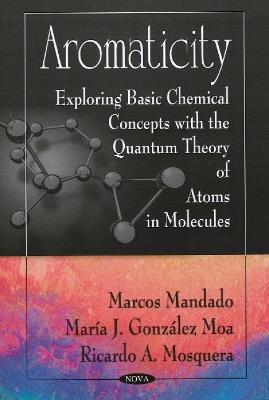
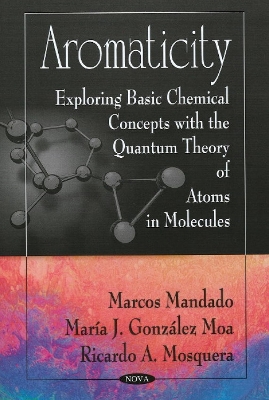
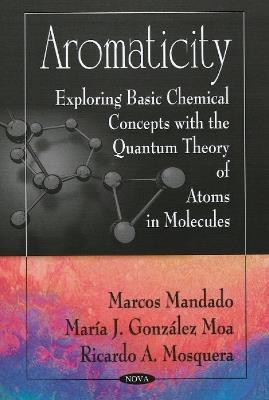
Aromaticity is among the most frequently used concepts in the chemical literature. Nevertheless, it has to be stressed that aromaticity is not an observable that could be directly obtained from molecular wave function. So, it remains as a controversial concept and its physical origin is still being debated. This has lead to multiple ways for assessing the aromatic or anti-aromatic character of molecules. Thus, several indices of aromaticity have been proposed throughout the literature. It is well-known that aromaticity is strongly related to the electron delocalisation of the electrons along all the centres of the ring. The introduction of the n-order density matrix, and development of n-centre delocalisation indices (n-DIs), has provided a quantitative tool to measure electron delocalisation within a certain ring. Therefore, n-DIs can be regarded as a promising way to determine the actual role played by electron delocalisation in aromaticity. n-DIs are found to be in line with most of the qualitative trends predicted by the harmonic oscillator model of aromaticity indices, HOMAs, aromaticity indices derived from the Chemical Graph Theory, properties of the ring critical points, and circuit resonance energies. It has to be noticed that the direct comparison of n-DIs computed for rings with a different number of centers does not provide a picture of relative aromatic stabilisation. In fact, aromatic stabilisation does not only depend on the extension of the electron delocalisation over the n centres, but also on the number of centres. n-DIs dependence on the number of centres and electrons in a ring prevents to use their direct comparison as a measure of aromatic stabilisation unless an appropriate scaling is applied. Effective Scaled Electron Delocalisation indices, ESED, have been developed for comparing the total aromaticity of polyaromatic hydrocarbons. n-DIs exhibit very different behaviour for aromatic and antiaromatic hydrocarbons. Thus, an aromatic compound is one whose multicenter electron delocalisation is larger than that of the corresponding linear structure, whereas an antiaromatic compound is one where the multi-centre electron delocalisation is smaller than that of the linear molecule. Those compounds that display very small differences between linear and cyclic structures may be called non-aromatic. n-DIs are also found as a promising tool to study the aromaticity of transition states in concerted processes. This book also reports on its application to the study of the aromaticity in all metal compounds.
Leggi di più
Leggi di meno
Editore:
Anno:
2008
Rilegatura:
Paperback / softback
Pagine:
72 p.
Testo in English
Dimensioni:
155 x 203 mm
Peso:
116 gr.
EAN:
9781604564082

L'articolo è stato aggiunto al carrello
Informazioni e Contatti sulla Sicurezza dei Prodotti
Le schede prodotto sono aggiornate in conformità al Regolamento UE 988/2023. Laddove ci fossero taluni dati non disponibili per ragioni indipendenti da IBS, vi informiamo che stiamo compiendo ogni ragionevole sforzo per inserirli. Vi invitiamo a controllare periodicamente il sito www.ibs.it per eventuali novità e aggiornamenti.
Per le vendite di prodotti da terze parti, ciascun venditore si assume la piena e diretta responsabilità per la commercializzazione del prodotto e per la sua conformità al Regolamento UE 988/2023, nonché alle normative nazionali ed europee vigenti.
Per informazioni sulla sicurezza dei prodotti, contattare productsafetyibs@feltrinelli.it
L’articolo è stato aggiunto alla lista dei desideri
