

L’articolo è stato aggiunto alla lista dei desideri










EBOOK IN LINGUA STRANIERA
 E-mail
 Facebook
 LinkedIn
 Twitter
 WhatsApp
Cognitive Alignment Theory
(0)
Cliccando su “Conferma” dichiari che il contenuto da te inserito è conforme alle Condizioni Generali d’Uso del Sito ed alle Linee Guida sui Contenuti Vietati. Puoi rileggere e modificare e successivamente confermare il tuo contenuto. Tra poche ore lo troverai online (in caso contrario verifica la conformità del contenuto alle policy del Sito).
Grazie per la tua recensione!
Tra poche ore la vedrai online (in caso contrario verifica la conformità del testo alle nostre linee guida). Dopo la pubblicazione per te +4 punti 
34,99 €
+350
punti 
Venditore: IBS

Acquista online
Scaricabile subito
Articolo acquistabile con Carta del Docente

Articolo acquistabile con Carta Cultura Giovani e Carta del Merito

Articolo acquistabile con Carta della Cultura

Abbonati a Kobo plus per avere accesso illimitato a questo contenuto

Dati e Statistiche
 Salvato in 0 liste dei desideri
Salvato in 0 liste dei desideri
Cognitive Alignment Theory
Scaricabile subito
34,99 €
34,99 €
Scaricabile subito
Altre offerte vendute e spedite dai nostri venditori

Ebook in lingua straniera
Cognitive Alignment Theory
Altri venditori
Prezzo e spese di spedizione
EBOOK INGLESE
EPUB2 con DRMFREE
Scaricabile subito

Venduto e spedito da
IBS
Spedizione Gratis
34,99 €
Altri venditori
Prezzo e spese di spedizione
EBOOK INGLESE
EPUB2 con DRMFREE
Scaricabile subito
Venduto e spedito da
IBS
Spedizione Gratis
34,99 €
Altri venditori
Prezzo e spese di spedizione

Tutti i formati ed edizioni

Promo attive (0)
Cognitive Alignment Theory
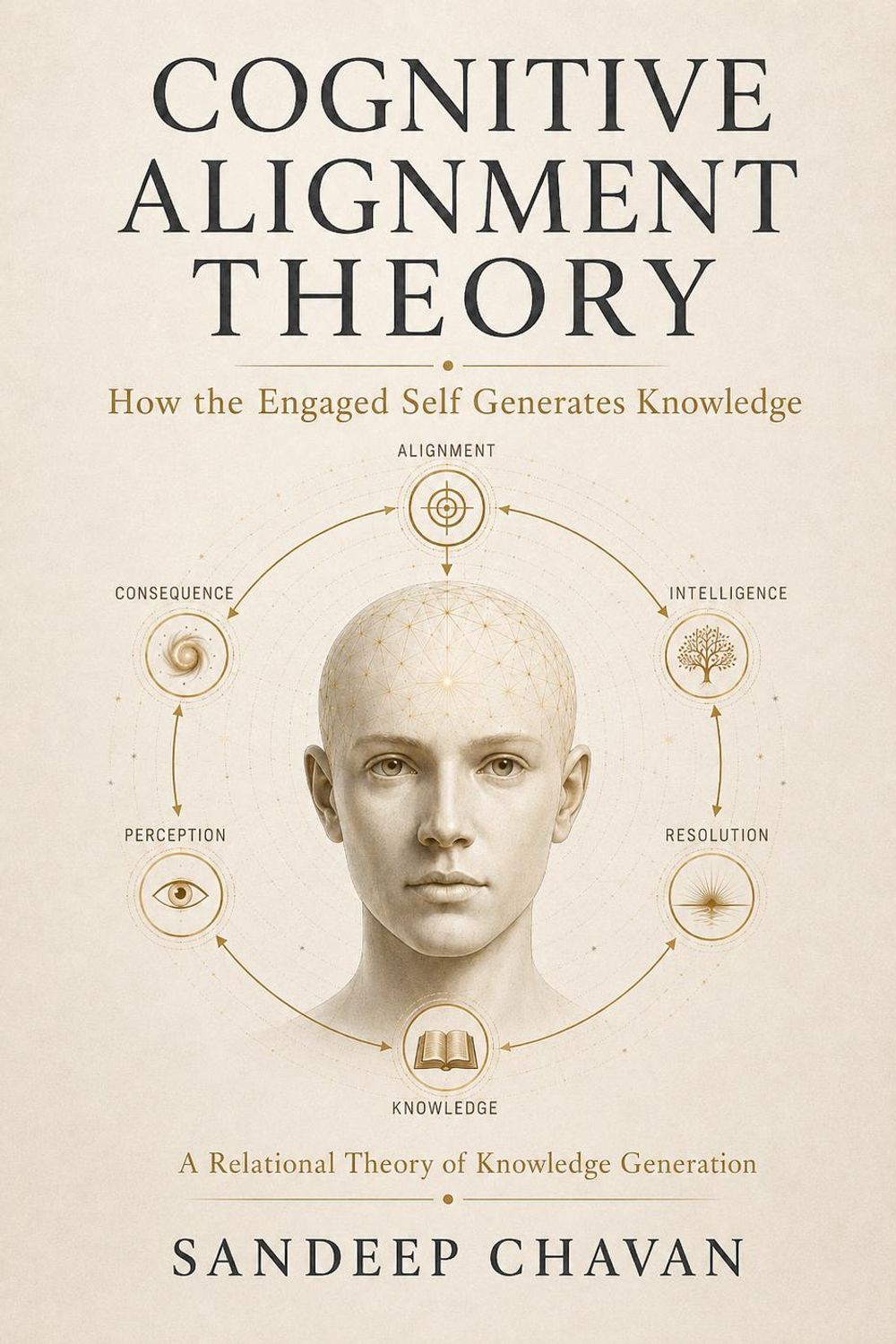
Why does the same explanation become knowledge for one learner while remaining only information for another? In Cognitive Alignment Theory: How the Engaged Self Generates Knowledge, independent researcher and educator Sandeep Chavan presents an original relational framework for understanding how perceived consequence becomes durable knowledge. The book begins with a distinction often overlooked in education and cognitive theory: perception does not automatically become knowledge. A learner may see, hear, read, remember, and even reproduce information without deeply reorganizing the cognitive field. Cognitive Alignment Theory follows the hidden process between perception and knowledge: Consequence ? Perception ? Awareness ? Alignment ? Engagement ? Cognitive Delta ? Capacity ? Intelligence ? Cognitive ATT ? Resolution ? Integration ? Consolidation ? Recall ? Application ? Transfer ? Correction ? Knowledge ? Reconfigured Perception At the centre of the theory is the engaged self—the continuing relational centre through which a consequence becomes relevant, unresolved, and capable of changing existing cognitive geometry. The book introduces and develops several original concepts, including Cognitive Delta, field capacity, awareness-mediated widening, learner-specific Cognitive Alignment Threshold Time, alignment–resolution learner profiles, consequence-bearing resolution, and knowledge as stabilized relational geometry. It also establishes several essential distinctions: Attention is not alignment. Awareness is not intelligence. Capacity is not intelligence. Speed is not a direct measure of intelligence. Resolution is not correctness. Recall is not the whole of knowing. Information may be transmitted, but knowledge must be generated. Drawing upon classroom observation, philosophical inquiry, cognitive science, and the wider Universal Energy Dynamics framework, the book examines why some perceptions dissipate, why some learners resolve quickly while others require longer cognitive ATT, how premature closure creates misunderstanding, why transfer reveals the quality of learning, and how correction keeps knowledge alive. The final sections convert the theory into a research programme through canonical definitions, a cognitive alignment process map, learner profiles, operational variables, testable predictions, comparison with mainstream cognitive science, and a careful examination of artificial systems and machine knowledge. Cognitive Alignment Theory is written for educators, psychologists, cognitive scientists, researchers, philosophers, students, AI thinkers, and readers interested in learning, intelligence, selfhood, awareness, knowledge formation, and correction. This is not a claim that knowledge has been finally explained. It is a structured and testable proposal about the process through which an engaged self generates knowledge—and how that knowledge changes the field through which the next consequence will be perceived.
Leggi di più
Leggi di meno
Autore:
Anno edizione:
2026
Editore:
Formato:
Lingua:
Inglese
Compatibilità:
Tutti i dispositivi (eccetto Kindle) Scopri di più
Layout:
Reflowable
EAN:
9798235345027
L'articolo è stato aggiunto al carrello
Formato:
Gli eBook venduti da IBS.it sono in formato ePub e possono essere protetti da Adobe DRM. In caso di download di un file protetto da DRM si otterrà un file in formato .acs, (Adobe Content Server Message), che dovrà essere aperto tramite Adobe Digital Editions e autorizzato tramite un account Adobe, prima di poter essere letto su pc o trasferito su dispositivi compatibili.
Cloud:
Gli eBook venduti da IBS.it sono sincronizzati automaticamente su tutti i client di lettura Kobo successivamente all’acquisto. Grazie al Cloud Kobo i progressi di lettura, le note, le evidenziazioni vengono salvati e sincronizzati automaticamente su tutti i dispositivi e le APP di lettura Kobo utilizzati per la lettura.
Clicca qui per sapere come scaricare gli ebook utilizzando un pc con sistema operativo Windows
L’articolo è stato aggiunto alla lista dei desideri
