

L’articolo è stato aggiunto alla lista dei desideri








LIBRO VINTAGE
 E-mail
 Facebook
 LinkedIn
 Twitter
 WhatsApp
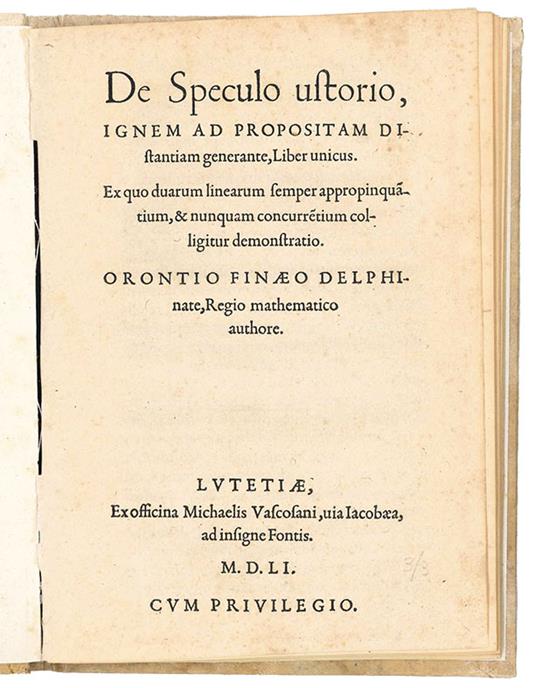
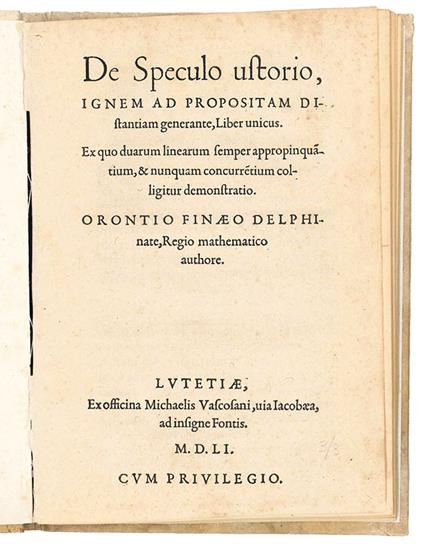
De speculo ustorio, ignem ad propositam distantiam generante, liber unicus. Ex quo duarum linearum semper appropinquantium, & numquam currurrentium colligitur demonstratio
(0)
Cliccando su “Conferma” dichiari che il contenuto da te inserito è conforme alle Condizioni Generali d’Uso del Sito ed alle Linee Guida sui Contenuti Vietati. Puoi rileggere e modificare e successivamente confermare il tuo contenuto. Tra poche ore lo troverai online (in caso contrario verifica la conformità del contenuto alle policy del Sito).
Grazie per la tua recensione!
Tra poche ore la vedrai online (in caso contrario verifica la conformità del testo alle nostre linee guida). Dopo la pubblicazione per te +4 punti 
Dati e Statistiche
 Salvato in 0 liste dei desideri
Salvato in 0 liste dei desideri
De speculo ustorio, ignem ad propositam distantiam generante, liber unicus. Ex quo duarum linearum semper appropinquantium, & numquam currurrentium colligitur demonstratio
Disponibilità immediata
2.200,00 €
2.200,00 €
Disponibilità immediata
Altre offerte vendute e spedite dai nostri venditori
Libri Vintage
De speculo ustorio, ignem ad propositam distantiam generante, liber unicus. Ex quo duarum linearum semper appropinquantium, & numquam currurrentium colligitur demonstratio
Altri venditori
Prezzo e spese di spedizione

LIBRO VINTAGE
Condizione accettabile
Disponibilità immediata

Venduto e spedito da
Libreria Alberto Govi
 5/
5
(5 opinioni)
5/
5
(5 opinioni)
Spedizione 5,00 €
2.200,00 €
Altri venditori
Prezzo e spese di spedizione
Altri venditori
Prezzo e spese di spedizione
LIBRO VINTAGE
Condizione accettabile
Disponibilità immediata
Venduto e spedito da
Libreria Alberto Govi
5/
5
(5 opinioni)
Spedizione 5,00 €
2.200,00 €

Tutti i formati ed edizioni
Promo attive (0)
THE FIRST MODERN TREATISE ON OPTICS PRINTED IN FRANCE 4to (199x139 mm). 25, [1 blank] leaves. Collation: A-E4 F6. The final leaf F6 is a blank. Roman and italic types. With several woodcut diagrams and illustrations in text. Modern stiff vellum. Some pale foxing and browning, but a good copy. Rare first edition of this treatise on burning glasses or concave mirrors, which includes mathematical analysis and methods of their construction. Such mirrors were used in metallurgy and in assaying. The edition is dedicated by the author to the English ambassador to France, Sir John Mason (dated Paris, October 1551). The dedication is followed by a poem by Antoine Mizault in praise of the work. As evidenced by a partial manuscript version of the treatise (Bibliothèque Nationale, Ms Lat. 7415, 10-17), which predates the printed edition by three years, the De speculo ustorio had in fact already been completed around 1548. The reason why Fine waited another three years before publishing it remains a mystery. The date of the manuscript, however, rules out any possibility that Fine's work was derived from that of Antonius Gogava, a mathematician in the circle of Gemma Frisius, who published a treatise on burning mirrors in Leuven in 1548 as an appendix to an edition of Ptolemy's Tetrabiblos that he had edited. On that occasion, Gogava also published Alhazen's De speculis comburentibus and a treatise of uncertain authorship (Speculi almukesi compositio) datable between 1250 and 1350, which Gogava attributes to Roger Bacon, while Fine considers it of Arabic origin; since it had been widely circulated in manuscript form, it is likely that Fine was familiar with the Speculi almukesi compositio (one of his primary sources) well before the printed edition of 1548. The De speculo ustorio consists of two parts: one geometric, dealing with the parabola, and the other, more “mechanical,” dealing with the construction of a parabolic mirror. Fine also places his mathematical discussion of the parabola within an optical context, setting forth four optical postulates at the beginning of the volume. The inclusion of optics within a work dedicated to burning mirrors, while it may seem obvious today, was by no means so in the mid-sixteenth century. Thanks to an Italian translation, the De speculo ustorio exerted great influence in Italy, especially through the work of Giovanni Battista della Porta, who drew heavily on Fine's treatise. “Oronce Fine set out to revive mathematics in Renaissance France, specifically in the curriculum at the Collège de France. De Speculo Ustorio and other books were his effort to provide the necessary awareness of mathematic and provide students textbooks. This is the origin of and intention for his textbook on mathematical optics and parabolic burring mirrors, which included mathematical analyses and methods of construction. As Fine stats in the preface, his most important optical source for De Speculo Ustorio was Witelo's Perspectiva. Though Fine likely had access to the Perspectiva's printing in 1535, it is known that he worked from a manuscript copy before the 1535 printing. His other optical source was an edited version of Alhazen's De Speculis Comburentibus which had been printed in 1548. Fine's parabolic geometry comes from Georgius Valla's De Expetendis et Fugiendis Rebus Opus of 1501 and from Johann Werner's Libellus of 1522. Though not of original material, the De Speculo Ustorio was a carefully crafted compilation of sections of select texts, comprising a much-need textbook on catoptrics. It was the first such book printed in France and like his other books was widely popular, esteemed for its careful presentation, straightforward Latin, and the excellence of its figures. De Speculo Ustorio, along with several other of his books, became widely used throughout Europe at universities in need of up-to-date textbooks. In this, Fine took advantage not only of his knowledge of optics and geometry, but also of the need and ab
Leggi di più
Leggi di meno
Venditore:
Libreria Alberto Govi
Vedi tutti i prodotti
Informazioni:
<p>THE FIRST MODERN TREATISE ON OPTICS PRINTED IN FRANCE</p> <p>4to (199x139 mm). 25, [1 blank] leaves. Collation: A-E<sup>4</sup> F<sup>6</sup>. The final leaf F6 is a blank. Roman and italic types. With several woodcut diagrams and illustrations in text. Modern stiff vellum. Some pale foxing and browning, but a good copy.</p> <p>Rare first edition of this treatise on burning glasses or concave mirrors, which includes mathematical analysis and methods of their construction. Such mirrors were used in metallurgy and in assaying. The edition is dedicated by the author to the English ambassador to France, Sir John Mason (dated Paris, October 1551). The dedication is followed by a poem by Antoine Mizault in praise of the work.</p> <p>As evidenced by a partial manuscript version of the treatise (Biblioth&egrave;que Nationale, Ms Lat. 7415, 10-17), which predates the printed edition by three years, the <em>De speculo ustorio</em> had in fact already been completed around 1548. The reason why Fine waited another three years before publishing it remains a mystery. The date of the manuscript, however, rules out any possibility that Fine's work was derived from that of Antonius Gogava, a mathematician in the circle of Gemma Frisius, who published a treatise on burning mirrors in Leuven in 1548 as an appendix to an edition of Ptolemy's Tetrabiblos that he had edited. On that occasion, Gogava also published Alhazen's <em>De speculis comburentibus</em> and a treatise of uncertain authorship (<em>Speculi almukesi compositio</em>) datable between 1250 and 1350, which Gogava attributes to Roger Bacon, while Fine considers it of Arabic origin; since it had been widely circulated in manuscript form, it is likely that Fine was familiar with the <em>Speculi almukesi compositio</em> (one of his primary sources) well before the printed edition of 1548.</p> <p>
Immagini:


- Prodotto usato
- Condizioni: Usato - Condizione accettabile
EAN:
2570270169335

L'articolo è stato aggiunto al carrello
Informazioni e Contatti sulla Sicurezza dei Prodotti
Le schede prodotto sono aggiornate in conformità al Regolamento UE 988/2023. Laddove ci fossero taluni dati non disponibili per ragioni indipendenti da IBS, vi informiamo che stiamo compiendo ogni ragionevole sforzo per inserirli. Vi invitiamo a controllare periodicamente il sito www.ibs.it per eventuali novità e aggiornamenti.
Per le vendite di prodotti da terze parti, ciascun venditore si assume la piena e diretta responsabilità per la commercializzazione del prodotto e per la sua conformità al Regolamento UE 988/2023, nonché alle normative nazionali ed europee vigenti.
Per informazioni sulla sicurezza dei prodotti, contattare productsafetyibs@feltrinelli.it
L’articolo è stato aggiunto alla lista dei desideri
