

L’articolo è stato aggiunto alla lista dei desideri








LIBRO VINTAGE
 E-mail
 Facebook
 LinkedIn
 Twitter
 WhatsApp
De tesseris hospitalitatis. Liber singularis, in quo ius hospitii vniuersum, apud veteres potissimum, expenditur. Auctore Iacobo Philippo Tomasino episcopo Aemoniensi
(0)
Cliccando su “Conferma” dichiari che il contenuto da te inserito è conforme alle Condizioni Generali d’Uso del Sito ed alle Linee Guida sui Contenuti Vietati. Puoi rileggere e modificare e successivamente confermare il tuo contenuto. Tra poche ore lo troverai online (in caso contrario verifica la conformità del contenuto alle policy del Sito).
Grazie per la tua recensione!
Tra poche ore la vedrai online (in caso contrario verifica la conformità del testo alle nostre linee guida). Dopo la pubblicazione per te +4 punti 
Dati e Statistiche
 Salvato in 0 liste dei desideri
Salvato in 0 liste dei desideri
De tesseris hospitalitatis. Liber singularis, in quo ius hospitii vniuersum, apud veteres potissimum, expenditur. Auctore Iacobo Philippo Tomasino episcopo Aemoniensi
Disponibilità immediata
800,00 €
800,00 €
Disponibilità immediata
Altre offerte vendute e spedite dai nostri venditori

Libri Vintage
De tesseris hospitalitatis. Liber singularis, in quo ius hospitii vniuersum, apud veteres potissimum, expenditur. Auctore Iacobo Philippo Tomasino episcopo Aemoniensi
Altri venditori
Prezzo e spese di spedizione

LIBRO VINTAGE
In buone condizioni
Disponibilità immediata

Venduto e spedito da
Libreria Alberto Govi
 5/
5
(5 opinioni)
5/
5
(5 opinioni)
Spedizione 5,00 €
800,00 €
Altri venditori
Prezzo e spese di spedizione
Altri venditori
Prezzo e spese di spedizione
LIBRO VINTAGE
In buone condizioni
Disponibilità immediata
Venduto e spedito da
Libreria Alberto Govi
5/
5
(5 opinioni)
Spedizione 5,00 €
800,00 €

Tutti i formati ed edizioni
Promo attive (0)
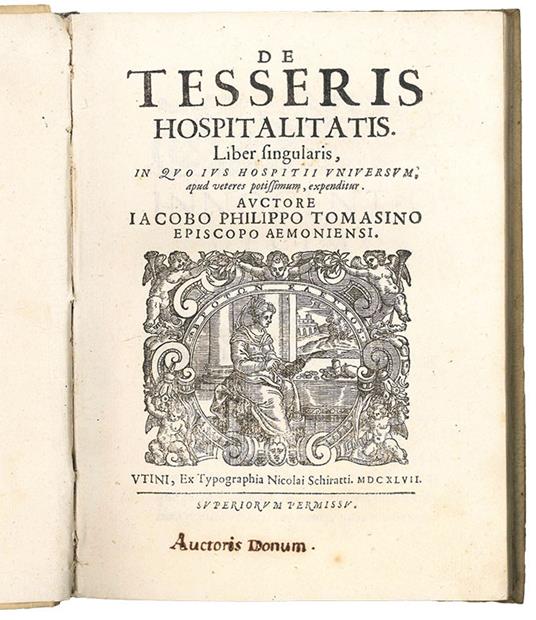
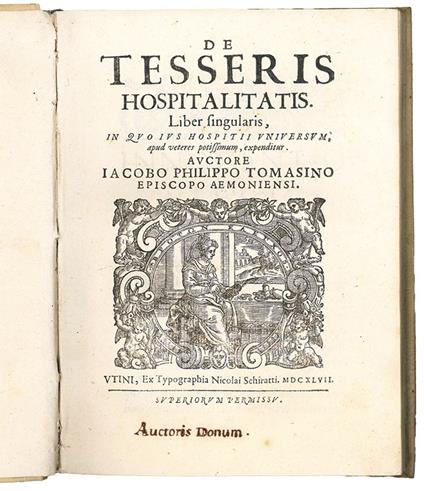
AUCTORIS DONUM 4to (211x155 mm). [16], 151, [1] pp. Collation: a-b4 A-T4. Large woodcut printer's device on the title page. Full-page engraving (“Tesserae antiquorum”) on p. 72 and 2 small woodcut illustrations on p. 149. Contemporary limp vellum with ink title along the spine. On the the title page manuscript note “Auctoris donum”. Worm track and worm holes to the bottom margin of several leaves at the center of the volume never affecting the text, otherwise a very good, genuine copy. First edition of this treatise on hospitality in Roman antiquity and the legal and social practices associated with it, with particular reference to hotels, taverns, food, banquets, dining customs and the use of coins, called “tesserae hospitales”, which entitled the bearer to hospitality while travelling. The work was reprinted in Amsterdam in 1670. Giacomo Filippo Tomasini, also encountered as Tommasini, was born at Padua on 17 November 1595 and died there on 13 June 1655. Ecclesiastic, antiquary, biographer, bibliographer, epigraphist and historian, he belonged to the learned culture that connected seventeenth-century Padua and Venice with the wider European Republic of Letters. His importance rests less on a single synthetic work than on the consistency with which he treated books, manuscripts, inscriptions, portraits, libraries, monuments and correspondence as documentary evidence. Tomasini repeatedly sought to preserve intellectual memory by fixing dispersed materials in print: cataloguing manuscript collections, reconstructing scholarly lives, recording inscriptions before their disappearance, describing collections and producing institutional histories from archival traces (cf. G. Trebbi, Tomasini, Giacomo Filippo, in: “Dizionario Biografico degli Italiani”, vol. 96. Rome, 2019, s.v.). Italian Union Catalogue, IT\ICCU\UM1E\006742; USTC, 4020478.
Leggi di più
Leggi di meno
Venditore:

Libreria Alberto Govi
Vedi tutti i prodotti
Informazioni:
<p>AUCTORIS DONUM</p> <p>4to (211x155 mm). [16], 151, [1] pp. Collation: a-b<sup>4</sup> A-T<sup>4</sup>. Large woodcut printer's device on the title page. Full-page engraving (&ldquo;Tesserae antiquorum&rdquo;) on p. 72 and 2 small woodcut illustrations on p. 149. Contemporary limp vellum with ink title along the spine. On the the title page manuscript note &ldquo;Auctoris donum&rdquo;. Worm track and worm holes to the bottom margin of several leaves at the center of the volume never affecting the text, otherwise a very good, genuine copy.</p> <p>First edition of this treatise on hospitality in Roman antiquity and the legal and social practices associated with it, with particular reference to hotels, taverns, food, banquets, dining customs and the use of coins, called &ldquo;tesserae hospitales&rdquo;, which entitled the bearer to hospitality while travelling. The work was reprinted in Amsterdam in 1670.</p> <p>Giacomo Filippo Tomasini, also encountered as Tommasini, was born at Padua on 17 November 1595 and died there on 13 June 1655. Ecclesiastic, antiquary, biographer, bibliographer, epigraphist and historian, he belonged to the learned culture that connected seventeenth-century Padua and Venice with the wider European Republic of Letters. His importance rests less on a single synthetic work than on the consistency with which he treated books, manuscripts, inscriptions, portraits, libraries, monuments and correspondence as documentary evidence. Tomasini repeatedly sought to preserve intellectual memory by fixing dispersed materials in print: cataloguing manuscript collections, reconstructing scholarly lives, recording inscriptions before their disappearance, describing collections and producing institutional histories from archival traces (cf. G. Trebbi, <em>Tomasini, Giacomo Filippo</em>, in: &ldquo;Dizionario Biografico degli Italiani&rdquo;, vol. 96.
Immagini:


- Prodotto usato
- Condizioni: Usato - In buone condizioni
EAN:
2570270169397

L'articolo è stato aggiunto al carrello
Informazioni e Contatti sulla Sicurezza dei Prodotti
Le schede prodotto sono aggiornate in conformità al Regolamento UE 988/2023. Laddove ci fossero taluni dati non disponibili per ragioni indipendenti da IBS, vi informiamo che stiamo compiendo ogni ragionevole sforzo per inserirli. Vi invitiamo a controllare periodicamente il sito www.ibs.it per eventuali novità e aggiornamenti.
Per le vendite di prodotti da terze parti, ciascun venditore si assume la piena e diretta responsabilità per la commercializzazione del prodotto e per la sua conformità al Regolamento UE 988/2023, nonché alle normative nazionali ed europee vigenti.
Per informazioni sulla sicurezza dei prodotti, contattare productsafetyibs@feltrinelli.it
L’articolo è stato aggiunto alla lista dei desideri
