

L’articolo è stato aggiunto alla lista dei desideri









LIBRO INGLESE
 E-mail
 Facebook
 LinkedIn
 Twitter
 WhatsApp
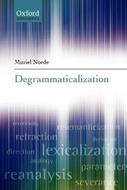
Degrammaticalization
(0)
Cliccando su “Conferma” dichiari che il contenuto da te inserito è conforme alle Condizioni Generali d’Uso del Sito ed alle Linee Guida sui Contenuti Vietati. Puoi rileggere e modificare e successivamente confermare il tuo contenuto. Tra poche ore lo troverai online (in caso contrario verifica la conformità del contenuto alle policy del Sito).
Grazie per la tua recensione!
Tra poche ore la vedrai online (in caso contrario verifica la conformità del testo alle nostre linee guida). Dopo la pubblicazione per te +4 punti 
70,40 €
+700
punti 
Venditore: IBS
Articolo acquistabile con Carta del Docente

Articolo acquistabile con Carta Cultura Giovani e Carta del Merito

Articolo acquistabile con Carta della Cultura

Paga con Klarna in 3 rate senza interessi per ordini superiori a 39 €

Dati e Statistiche
 Salvato in 0 liste dei desideri
Salvato in 0 liste dei desideri
Degrammaticalization
Disponibilità in 2 settimane
70,40 €
70,40 €
Disponibilità in 2 settimane
Altre offerte vendute e spedite dai nostri venditori
Libri in Inglese
Degrammaticalization
Altri venditori
Prezzo e spese di spedizione

LIBRO INGLESE
Disponibilità in 2 settimane

Venduto e spedito da
IBS
Spedizione Gratis
70,40 €
Altri venditori
Prezzo e spese di spedizione
LIBRO INGLESE
Disponibilità in 2 settimane
Venduto e spedito da
IBS
Spedizione Gratis
70,40 €
Altri venditori
Prezzo e spese di spedizione

Tutti i formati ed edizioni

Promo attive (0)
Grammaticalization is a well-attested process of linguistic change in which a lexical item becomes a function word, which may be further reduced to a clitic or affix. Proponents of the universality of grammaticalization have usually argued that it is unidirectional and have thus found it a useful tool in linguistic reconstruction. In this book Prof Norde shows that change is reversible on all levels: semantic, morphological, syntactic, and phonological. As a consequence, the alleged unidirectionality of grammaticalization is not a reliable reconstructional tool, even if degrammaticalization is a rare phenomenon. Degrammaticalization, she argues, is essentially different from grammaticalization: it usually comprises a single change, examples being shifts from affix to clitic, or from function word to lexical item. And where grammaticalization can be seen as a process, degrammaticalization is often the by-product of other changes. Nevertheless, she shows that it can be described, like grammaticalization, in a principled way, in order to establish whether a change in a word has been from more to less grammatical or vice versa, and the stages by which it has become so. Using data from different languages she constructs a typology of degrammaticalization changes. She explains why degrammaticalization is so rare and why some linguists have such strongly negative feelings about the possibility of its existence. She adds to the understanding of grammaticalization and makes a significant contribution to methods of linguistic reconstruction and the study of language change. She writes clearly, aiming to be understood by advanced undergraduate students as well as appealing to scholars and graduate researchers in historical linguistics.
Leggi di più
Leggi di meno
Autore:
Editore:
Anno:
2009
Rilegatura:
Paperback / softback
Pagine:
290 p.
Testo in English
Dimensioni:
234 x 155 mm
Peso:
447 gr.
EAN:
9780199207930

L'articolo è stato aggiunto al carrello
Informazioni e Contatti sulla Sicurezza dei Prodotti
Le schede prodotto sono aggiornate in conformità al Regolamento UE 988/2023. Laddove ci fossero taluni dati non disponibili per ragioni indipendenti da IBS, vi informiamo che stiamo compiendo ogni ragionevole sforzo per inserirli. Vi invitiamo a controllare periodicamente il sito www.ibs.it per eventuali novità e aggiornamenti.
Per le vendite di prodotti da terze parti, ciascun venditore si assume la piena e diretta responsabilità per la commercializzazione del prodotto e per la sua conformità al Regolamento UE 988/2023, nonché alle normative nazionali ed europee vigenti.
Per informazioni sulla sicurezza dei prodotti, contattare productsafetyibs@feltrinelli.it
L’articolo è stato aggiunto alla lista dei desideri
