

L’articolo è stato aggiunto alla lista dei desideri









LIBRO VINTAGE
 E-mail
 Facebook
 LinkedIn
 Twitter
 WhatsApp
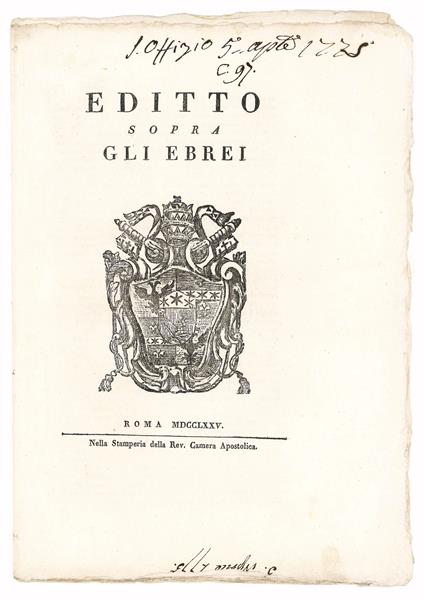
Editto sopra gli Ebrei
(0)
Cliccando su “Conferma” dichiari che il contenuto da te inserito è conforme alle Condizioni Generali d’Uso del Sito ed alle Linee Guida sui Contenuti Vietati. Puoi rileggere e modificare e successivamente confermare il tuo contenuto. Tra poche ore lo troverai online (in caso contrario verifica la conformità del contenuto alle policy del Sito).
Grazie per la tua recensione!
Tra poche ore la vedrai online (in caso contrario verifica la conformità del testo alle nostre linee guida). Dopo la pubblicazione per te +4 punti 
Dati e Statistiche
 Salvato in 0 liste dei desideri
Salvato in 0 liste dei desideri
Editto sopra gli Ebrei
Disponibilità immediata
780,00 €
780,00 €
Disponibilità immediata
Altre offerte vendute e spedite dai nostri venditori

Libri Vintage
Editto sopra gli Ebrei
Altri venditori
Prezzo e spese di spedizione

Usato - In buone condizioni
 5/
5
(2 opinioni)
5/
5
(2 opinioni)
Disponibilità immediata

Venduto e spedito da
Libreria Alberto Govi
5/
5
(2 opinioni)
Spedizione 5,00 €
780,00 €
Altri venditori
Prezzo e spese di spedizione
Altri venditori
Prezzo e spese di spedizione
Usato - In buone condizioni
5/
5
(2 opinioni)
Disponibilità immediata
Venduto e spedito da
Libreria Alberto Govi
5/
5
(2 opinioni)
Spedizione 5,00 €
780,00 €

Tutti i formati ed edizioni
Promo attive (0)
Folio (290x205 mm). 12 pp. With woodcut papal arms on the title page. Later wrappers. A very good copy. Uncut.
Original printed edict in Italian, issued by the Inquisition of Rome on 5 April 1775 and affixed on 20 April, relating to laws affecting the Jews.
In the opening words, the notary of the Holy Inquisition states that this same decree had been issued by Clement XII in 1733 and Benedict XIV in 1751, and now orders its publication and punctilious fulfilment.
Historically, it is a most interesting record of both the great and petty tyranny that was inflicted on the Jews, and of the tortuous methods employed by the Inquisition in enforcing their malicious laws. There are forty-four clauses in this edict, the forty-third-compelling Jews to attend evangelical sermons-being, perhaps, the most pernicious in its sublety.
No Jew was to possess, buy, write, copy, translate, sell, give or otherwise dispose of, in any manner whatsoever, “any codex or book on the Talmud, Cabbala or the Old Testament; or anything containing errors against the mysteries of Christianity and the Trinity”; neither might the Jews teach Hebrew or any other religious doctrine, sub paena of “loss of books, confiscation of property, and other penalties”. Printers of such books likewise incurred the same penalties.
Jews were forbidden to utter prophecies or teach anything appertaining to the occult; Christian silversmiths were forbidden to make amulets or charms for Jews “who are in the habit of giving them to their children to wear”; or to fashion candelabra with seven sconces which the Jews used.
They might light candles and practise funeral rites in the Synagogue, provided no Christian was present, but no funeral procession was permitted. No Jew was allowed to entertain under his room any neophyte or catechumen; or to dissuade anyone, however indirectly, from converting to Christianity, under penalty of the galley, imprisonment, confiscation of goods, or fines.
Both Jews and Jewesses were to wear conspicuously upon their dress, the distinguishing yellow badge, in and outside the Ghetto, and in Rome, but might be excused on a journey.
Jews were not allowed to sell, or otherwise distribute, meat, bread or milk, and might only purchase sufficient for their own use but not for purposes of trade. They were not permitted to purchase or sell Images, pictures, crucifixes, breviaries, missals, altar cloths, or any sacred ornaments used in churches, sub paena of a fine, which the Christian associate was also liable to incur, and punishment in the galley. The punishment for any Jew having commercial or financial relations with a catechumen was a fine, a public flogging, and other “arbitrary” punishments!
No Jew might keep a shop or lodging-house outside the Ghetto; or hold a meeting with Christians or even with Jews in the public market-place, sub paena of the loss of his shop.
Jews might not invite Christians into the Synagogue, and the penalty for Christians entering such place of worship was a fine of fifty scudos. Jews were forbidden to enter into any contract for leaseholds; to avail themselves of the services of Christian nurses and midwives; of permanent or temporary servants, even “for the briefest moment to light their fires” (presumably on the Sabbath); to converse or fraternise with Christians “in the palaces, houses or vineyards, or the streets, inns, taverns or elsewhere”; to drive in a carriage in Rome or its environs, sub poena of imprisonment; the only exception being in the case of a journey, when permission might be granted for the use of a horse or public coach, but no Christian or Jew might serve a Jew as coachman, etc.
Leggi di più
Leggi di meno
Venditore:

Libreria Alberto Govi
Vedi tutti i prodotti
Informazioni:
<p>Folio (290x205 mm). 12 pp. With woodcut papal arms on the title page. Later wrappers. A very good copy. Uncut.</p> <p>Original printed edict in Italian, issued by the Inquisition of Rome on 5 April 1775 and affixed on 20 April, relating to laws affecting the Jews.</p> <p>In the opening words, the notary of the Holy Inquisition states that this same decree had been issued by Clement XII in 1733 and Benedict XIV in 1751, and now orders its publication and punctilious fulfilment.</p> <p>Historically, it is a most interesting record of both the great and petty tyranny that was inflicted on the Jews, and of the tortuous methods employed by the Inquisition in enforcing their malicious laws. There are forty-four clauses in this edict, the forty-third-compelling Jews to attend evangelical sermons-being, perhaps, the most pernicious in its sublety.</p> <p>No Jew was to possess, buy, write, copy, translate, sell, give or otherwise dispose of, in any manner whatsoever, &ldquo;any codex or book on the Talmud, Cabbala or the Old Testament; or anything containing errors against the mysteries of Christianity and the Trinity&rdquo;; neither might the Jews teach Hebrew or any other religious doctrine, sub paena of &ldquo;loss of books, confiscation of property, and other penalties&rdquo;. Printers of such books likewise incurred the same penalties.</p> <p>Jews were forbidden to utter prophecies or teach anything appertaining to the occult; Christian silversmiths were forbidden to make amulets or charms for Jews &ldquo;who are in the habit of giving them to their children to wear&rdquo;; or to fashion candelabra with seven sconces which the Jews used.</p> <p>They might light candles and practise funeral rites in the Synagogue, provided no Christian was present, but no funeral procession was permitted. No Jew was allowed to entertain under his room any neophyte or catechumen; or to
Immagini:


Tipologia:
Anno edizione:
1775
- Prodotto usato
- Condizioni: Usato - In buone condizioni
EAN:
2570270159190

L'articolo è stato aggiunto al carrello
Informazioni e Contatti sulla Sicurezza dei Prodotti
Le schede prodotto sono aggiornate in conformità al Regolamento UE 988/2023. Laddove ci fossero taluni dati non disponibili per ragioni indipendenti da IBS, vi informiamo che stiamo compiendo ogni ragionevole sforzo per inserirli. Vi invitiamo a controllare periodicamente il sito www.ibs.it per eventuali novità e aggiornamenti.
Per le vendite di prodotti da terze parti, ciascun venditore si assume la piena e diretta responsabilità per la commercializzazione del prodotto e per la sua conformità al Regolamento UE 988/2023, nonché alle normative nazionali ed europee vigenti.
Per informazioni sulla sicurezza dei prodotti, contattare productsafetyibs@feltrinelli.it
L’articolo è stato aggiunto alla lista dei desideri
Siamo spiacenti si è verificato un errore imprevisto, la preghiamo di riprovare.
Verrai avvisato via email sulle novità di Nome Autore
