

L’articolo è stato aggiunto alla lista dei desideri









LIBRO INGLESE
 E-mail
 Facebook
 LinkedIn
 Twitter
 WhatsApp
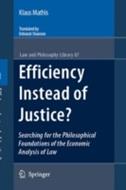
Efficiency Instead of Justice?: Searching for the Philosophical Foundations of the Economic Analysis of Law
(0)
Cliccando su “Conferma” dichiari che il contenuto da te inserito è conforme alle Condizioni Generali d’Uso del Sito ed alle Linee Guida sui Contenuti Vietati. Puoi rileggere e modificare e successivamente confermare il tuo contenuto. Tra poche ore lo troverai online (in caso contrario verifica la conformità del contenuto alle policy del Sito).
Grazie per la tua recensione!
Tra poche ore la vedrai online (in caso contrario verifica la conformità del testo alle nostre linee guida). Dopo la pubblicazione per te +4 punti 
132,30 €
+1320
punti 
Venditore: IBS
Articolo acquistabile con Carta del Docente

Articolo acquistabile con Carta Cultura Giovani e Carta del Merito

Articolo acquistabile con Carta della Cultura

Paga con Klarna in 3 rate senza interessi per ordini superiori a 39 €

Dati e Statistiche
 Salvato in 0 liste dei desideri
Salvato in 0 liste dei desideri
Efficiency Instead of Justice?: Searching for the Philosophical Foundations of the Economic Analysis of Law
Disponibilità in 2 settimane
132,30 €
132,30 €
Disponibilità in 2 settimane
Altre offerte vendute e spedite dai nostri venditori
Libri in Inglese
Efficiency Instead of Justice?: Searching for the Philosophical Foundations of the Economic Analysis of Law
Altri venditori
Prezzo e spese di spedizione

LIBRO INGLESE
Disponibilità in 2 settimane

Venduto e spedito da
IBS
Spedizione Gratis
132,30 €
Altri venditori
Prezzo e spese di spedizione
LIBRO INGLESE
Disponibilità in 2 settimane
Venduto e spedito da
IBS
Spedizione Gratis
132,30 €
Altri venditori
Prezzo e spese di spedizione

Tutti i formati ed edizioni

Promo attive (0)
Economic analysis of law is an interesting and challenging attempt to employ the concepts and reasoning methods of modern economic theory so as to gain a deeper understanding of legal problems. According to Richard A. Posner it is the role of the law to encourage market competition and, where the market fails because transaction costs are too high, to simulate the result of competitive markets. This would maximize economic efficiency and social wealth. In this work, the lawyer and economist Klaus Mathis critically appraises Posner’s normative justification of the efficiency paradigm from the perspective of the philosophy of law. Posner acknowledges the influences of Adam Smith and Jeremy Bentham, whom he views as the founders of normative economics. He subscribes to Smith’s faith in the market as an ideal allocation model, and to Bentham’s ethical consequentialism. Finally, aligning himself with John Rawls’s contract theory, he seeks to legitimize his concept of wealth maximization with a consensus theory approach. In his interdisciplinary study, the author points out the possibilities as well as the limits of economic analysis of law. It provides a method of analysing the law which, while very helpful, is also rather specific. The efficiency arguments therefore need to be incorporated into a process for resolving value conflicts. In a democracy this must take place within the political decision-making process. In this clearly written work, Klaus Mathis succeeds in making even non-economists more aware of the economic aspects of the law.
Leggi di più
Leggi di meno
Autore:
Traduttore:
Editore:
Collana:
Law and Philosophy Library
Anno:
2009
Rilegatura:
Hardback
Pagine:
220 p.
Testo in English
Dimensioni:
235 x 155 mm
EAN:
9781402097973

L'articolo è stato aggiunto al carrello
Informazioni e Contatti sulla Sicurezza dei Prodotti
Le schede prodotto sono aggiornate in conformità al Regolamento UE 988/2023. Laddove ci fossero taluni dati non disponibili per ragioni indipendenti da IBS, vi informiamo che stiamo compiendo ogni ragionevole sforzo per inserirli. Vi invitiamo a controllare periodicamente il sito www.ibs.it per eventuali novità e aggiornamenti.
Per le vendite di prodotti da terze parti, ciascun venditore si assume la piena e diretta responsabilità per la commercializzazione del prodotto e per la sua conformità al Regolamento UE 988/2023, nonché alle normative nazionali ed europee vigenti.
Per informazioni sulla sicurezza dei prodotti, contattare productsafetyibs@feltrinelli.it
L’articolo è stato aggiunto alla lista dei desideri
