

L’articolo è stato aggiunto alla lista dei desideri


EBOOK IN LINGUA STRANIERA
 E-mail
 Facebook
 LinkedIn
 Twitter
 WhatsApp
Evaluating Gen AI Applications - A Practitioner’s Playbook for Testing What AI Actually Gets Right
(0)
Cliccando su “Conferma” dichiari che il contenuto da te inserito è conforme alle Condizioni Generali d’Uso del Sito ed alle Linee Guida sui Contenuti Vietati. Puoi rileggere e modificare e successivamente confermare il tuo contenuto. Tra poche ore lo troverai online (in caso contrario verifica la conformità del contenuto alle policy del Sito).
Grazie per la tua recensione!
Tra poche ore la vedrai online (in caso contrario verifica la conformità del testo alle nostre linee guida). Dopo la pubblicazione per te +4 punti 
8,49 €
+80
punti 
Prezzo minimo ultimi 30 giorni: 6,99 €
Venditore: IBS

Acquista online
Scaricabile subito
Articolo acquistabile con Carta del Docente

Articolo acquistabile con Carta Cultura Giovani e Carta del Merito

Articolo acquistabile con Carta della Cultura

Abbonati a Kobo plus per avere accesso illimitato a questo contenuto

Dati e Statistiche
 Salvato in 0 liste dei desideri
Evaluating Gen AI Applications - A Practitioner’s Playbook for Testing What AI Actually Gets Right
Scaricabile subito
8,49 €
8,49 €
Scaricabile subito
Altre offerte vendute e spedite dai nostri venditori

Ebook in lingua straniera
Evaluating Gen AI Applications - A Practitioner’s Playbook for Testing What AI Actually Gets Right
Altri venditori
Prezzo e spese di spedizione
EBOOK INGLESE
EPUB3 con DRMFREE
Scaricabile subito

Venduto e spedito da
IBS
Spedizione Gratis
8,49 €
Altri venditori
Prezzo e spese di spedizione
EBOOK INGLESE
EPUB3 con DRMFREE
Scaricabile subito
Venduto e spedito da
IBS
Spedizione Gratis
8,49 €
Altri venditori
Prezzo e spese di spedizione

Tutti i formati ed edizioni
Promo attive (0)
Evaluating Gen AI Applications - A Practitioner’s Playbook for Testing What AI Actually Gets Right
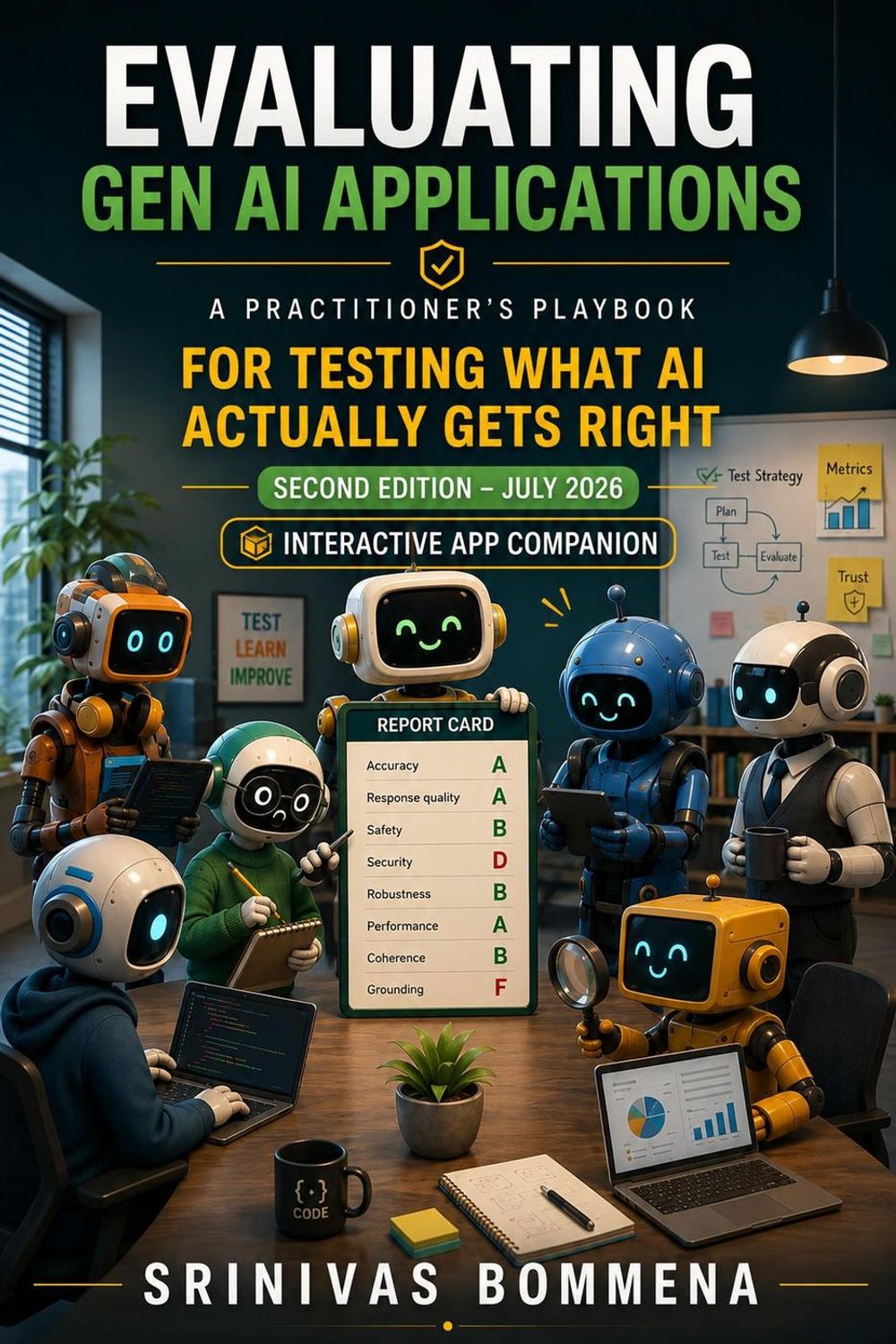
A Gen AI system can produce an excellent answer and still fail in production. An agent can complete every individual step and still leave the business process in the wrong state. So what evidence is strong enough to release it—and what evidence should make you stop? Evaluating Gen AI Systems and Agents — Third Editionis a practitioner's guide to making evaluation a repeatable engineering discipline across Gen AI applications, RAG systems, coding and reasoning workflows, and AI agents. The Third Edition develops that operating model through six connected themes. Foundations of Evaluation — from uncertainty to an evidence system. Start with the cost of flying blind, build a small evaluation suite, understand the evaluation stack and engineer a reproducible pipeline. Learn how to validate the evaluation harness itself, distinguish different dimensions of system quality and connect technical results to business outcomes rather than stopping at an aggregate score. Building the Evaluation Assets — make what you know reusable. Turn requirements, prompt behaviour and production failures into versioned evaluation contracts. Build governed datasets for development, capability discovery, regression protection, protected holdouts, production learning and simulation so that every model, prompt or application change does not force the organisation to rediscover the same failures. Operating Evaluation in Production — evaluation does not stop at release. Connect observability, run and trace evidence, thread and session evidence, production alerts, regression suites, release gates and human review. Learn how production failures become permanent tests, how mature capability evaluations graduate into regression protection and how teams preserve a reconstructable release decision when automation alone cannot settle the case. Evaluating Complex Gen AI Systems — test the system, not only the final response. Evaluate multi-step agents, synthetic-user simulations, RAG pipelines, code generation, reasoning workflows, model migrations and fine-tuning decisions. Separate step behaviour, run or trajectory quality, session outcome and external workflow state. Risk, Trust and Governance — turn evaluation evidence into assurance. Extend the evaluation system into fairness, representation and accessibility; adversarial testing and red teaming; governance, exceptions, decision rights and the 90-day operating roadmap. Security coverage uses OWASP guidance and MITRE ATLAS as coverage lenses, while governance evidence is mapped pragmatically to NIST AI RMF, the NIST Generative AI Profile, ISO/IEC 42001 and applicable regulatory obligations. Implementing the Evaluation System — turn the architecture into something teams can build. The final part converts the preceding nineteen chapters into an implementation-selection guide. Project managers learn what evidence to demand and how to challenge a proposed solution; developers get concrete implementation contracts and proof obligations. Throughout the book, Meridian Insurance provides a continuous enterprise scenario. Failures move from development datasets into regression, production monitoring, human review, model migration, economics, adversarial testing and governance. The Third Edition also includes eight optional browser-based companion labs covering the first evaluation suite, evaluation-stack architecture, dataset auditing, agent run and session evaluation, RAG diagnosis, code and reasoning verification, model-migration decisions and evaluation economics. The central question is no longer simply: "Did the model give the right answer?" It is: "What evidence would make us confident enough to let this system or agent act in real work"
Leggi di più
Leggi di meno
Autore:
Anno edizione:
2026
Editore:
Formato:
Lingua:
Inglese
Compatibilità:
Tutti i dispositivi (eccetto Kindle) Scopri di più
Layout:
Reflowable
EAN:
9798235886612
L'articolo è stato aggiunto al carrello
Formato:
Gli eBook venduti da IBS.it sono in formato ePub e possono essere protetti da Adobe DRM. In caso di download di un file protetto da DRM si otterrà un file in formato .acs, (Adobe Content Server Message), che dovrà essere aperto tramite Adobe Digital Editions e autorizzato tramite un account Adobe, prima di poter essere letto su pc o trasferito su dispositivi compatibili.
Cloud:
Gli eBook venduti da IBS.it sono sincronizzati automaticamente su tutti i client di lettura Kobo successivamente all’acquisto. Grazie al Cloud Kobo i progressi di lettura, le note, le evidenziazioni vengono salvati e sincronizzati automaticamente su tutti i dispositivi e le APP di lettura Kobo utilizzati per la lettura.
Clicca qui per sapere come scaricare gli ebook utilizzando un pc con sistema operativo Windows
L’articolo è stato aggiunto alla lista dei desideri
