

L’articolo è stato aggiunto alla lista dei desideri








![[...] In decem libros M. Vitruvii Pollionis De architectura annotationes [...] Cum indicibus Graeco & Latino locupletissimis. Colophon: Impressum Romae, apud Io. Andream Dossena Thaurinensem, M.D.XLIIII - copertina](https://www.ibs.it/images/2570270145919_0_0_536_0_75.jpg)
LIBRO VINTAGE
 E-mail
 Facebook
 LinkedIn
 Twitter
 WhatsApp
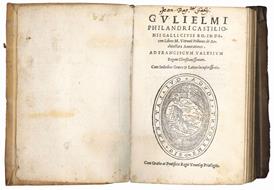
[...] In decem libros M. Vitruvii Pollionis De architectura annotationes [...] Cum indicibus Graeco & Latino locupletissimis. Colophon: Impressum Romae, apud Io. Andream Dossena Thaurinensem, M.D.XLIIII
(0)
Cliccando su “Conferma” dichiari che il contenuto da te inserito è conforme alle Condizioni Generali d’Uso del Sito ed alle Linee Guida sui Contenuti Vietati. Puoi rileggere e modificare e successivamente confermare il tuo contenuto. Tra poche ore lo troverai online (in caso contrario verifica la conformità del contenuto alle policy del Sito).
Grazie per la tua recensione!
Tra poche ore la vedrai online (in caso contrario verifica la conformità del testo alle nostre linee guida). Dopo la pubblicazione per te +4 punti 
Dati e Statistiche
 Salvato in 0 liste dei desideri
Salvato in 0 liste dei desideri
[...] In decem libros M. Vitruvii Pollionis De architectura annotationes [...] Cum indicibus Graeco & Latino locupletissimis. Colophon: Impressum Romae, apud Io. Andream Dossena Thaurinensem, M.D.XLIIII
Disponibilità immediata
2.800,00 €
2.800,00 €
Disponibilità immediata
Altre offerte vendute e spedite dai nostri venditori
Libri Vintage
[...] In decem libros M. Vitruvii Pollionis De architectura annotationes [...] Cum indicibus Graeco & Latino locupletissimis. Colophon: Impressum Romae, apud Io. Andream Dossena Thaurinensem, M.D.XLIIII
Altri venditori
Prezzo e spese di spedizione

Usato - Condizione accettabile
 5/
5
(2 opinioni)
5/
5
(2 opinioni)
Disponibilità immediata

Venduto e spedito da
Libreria Alberto Govi
5/
5
(2 opinioni)
Spedizione 5,00 €
2.800,00 €
Altri venditori
Prezzo e spese di spedizione
Altri venditori
Prezzo e spese di spedizione
Usato - Condizione accettabile
5/
5
(2 opinioni)
Disponibilità immediata
Venduto e spedito da
Libreria Alberto Govi
5/
5
(2 opinioni)
Spedizione 5,00 €
2.800,00 €

Tutti i formati ed edizioni
![[...] In decem libros M. Vitruvii Pollionis De architectura annotationes [...] Cum indicibus Graeco & Latino locupletissimis. Colophon: Impressum Romae, apud Io. Andream Dossena Thaurinensem, M.D.XLIIII - copertina](https://www.ibs.it/images/2570270145919_0_0_424_0_75.jpg)
Promo attive (0)
8vo (155x99 mm). [16], 369, [39] pp. Collation: a8 A-Z8 &8 AA8 BB4. Large printer's device on the title page and 65 woodcut illustrations in text. Colophon on last leaf verso. Woodcut initials. Italic, Greek, and Roman type. Contemporary flexible vellum with overlapping edges and inked title on spine (traces of ties). Ownership entry on the title page “Joan. Bap.ta Gabii”. Small hole on l. H1 with some loss of text, quire T slightly browned, otherwise a very good, extremely genuine copy in its first binding.
Scarce first edition, dedicated to the King of France Francis I, of Philandrier commentary on Vitruvius, that was reprinted in Paris in 1545 and later issued accompanying Vitruvius's actual text in Strasbourg in 1550 in 16mo and in De Tournes' enlarged 4to format in Lyons in 1552.
The edition opens with a note to the scholars (“studiosis”), a six-page long list of quoted authors, and a short life of Vitruvius based on the autobiographical references that can be found in his own work.
As secretary to Cardinal Georges D'Armagnac, Philandrier lived in Rome for a few years, becoming a member of the famous Accademia della Virtù, which, founded by Claudio Tolomei in 1538 under the protection of Cardinal Ippolito de' Medici, had been established for the main purpose of studying and commenting on the work of Vitruvius (see M. Maylender, Storia delle accademie d'Italia, Bologna, 1926-‘30, V, pp. 478-480). The academy, whose members included Marcello Cervini (the future Pope Marcellus II), Jacopo Barozzi called Il Vignola, Alessandro Manzuoli, Luca Contile, Annibal Caro, Marco Antonio Flaminio, and Francesco Maria Molza, to name but a few, met twice a week at the residence of Archbishop Francesco Colonna; during the meetings Vitrivius' De Architectura was read and discussed in order to publish a comprehensive annotated edition of the work. The activity and goals of the Accademia della Virtù are outlined by Tolomei in a very interesting letter to Count Agostino Landi, dated 14 November 1542 (cf. D. Wiebenson, ed., Architectural Theory and Practice from Alberti to Ledoux, Chicago, IL, 1982, pp. 1-13).
It was precisely during his stay in Rome that Philander (known in Italian as Filandro and in Latin as Philander) produced his Annotationes, which remained the only published outcome of the ambitious project of the Accademia della Virtù (cf. F. Lemerle, Philandrier et le texte de Vitruve, in: “Mélanges de l'École française de Rome, Italie et Méditerranée”, 106, no. 2, 1994, pp. 517-529).
“Philander's commentary is composed of sections of the text followed by practical explanations and definitions, each passage heavily reinforced with scholarly and classical examples […] Philander's work is at once a learned study and a practical manual of architecture, incorporating the methods of both the humanists and architects […] It is the first synthesis of academic and practical interpretations of Vitruvius' treatise to appear in published form. The contribution of Philander and of the Accademia delle Virtù to mid-sixteenth-century architectural theory is of the greatest importance […] Philander's notes would be cited almost without exception by every Vitruvius commentator and translator, from the date of its first appearance until the nineteenth century” (D. Wiebenson, ed., The Mark J. Millard Architectural Collection, I:
Leggi di più
Leggi di meno
Venditore:

Libreria Alberto Govi
Vedi tutti i prodotti
Informazioni:
<p>8vo (155x99 mm). [16], 369, [39] pp. Collation: a<sup>8</sup> A-Z<sup>8</sup> &amp;<sup>8</sup> AA<sup>8</sup> BB<sup>4</sup>. Large printer's device on the title page and 65 woodcut illustrations in text. <em>Colophon</em> on last leaf verso. Woodcut initials. Italic, Greek, and Roman type. Contemporary flexible vellum with overlapping edges and inked title on spine (traces of ties). Small hole on l. H1 with some loss of text, quire T slightly browned, otherwise a very good, extremely genuine copy in its first binding.</p> <p>Provenance. Ownership entry on the title page &ldquo;Joan. Bap.<sup>ta</sup> Gabii&rdquo;. Giovan Battista Gabia, born in Verona in the early 16<sup>th</sup> century, was a professor of Greek at the University of Rome from around 1553 until 1582. Alongside teaching, he was also active as a translator and editor of Greek and Hebrew texts. In 1583, he published in Rome a translation of the Gregorian calendar into Greek. He probably died around 1590 (cf. E. Del Gallo, <em>Gabia, Giovan Battista</em>, in: &ldquo;Dizionario Biografico degli Italiani&rdquo;, vol. 51, 1998, s.v.).</p> <p>Scarce first edition, dedicated to the King of France Francis I, of Philandrier commentary on Vitruvius, that was reprinted in Paris in 1545 and later issued accompanying Vitruvius's actual text in Strasbourg in 1550 in 16mo and in De Tournes' enlarged 4to format in Lyons in 1552.</p> <p>The edition opens with a note to the scholars (&ldquo;studiosis&rdquo;), a six-page long list of quoted authors, and a short life of Vitruvius based on the autobiographical references that can be found in his own work.</p> <p>As secretary to Cardinal Georges D'Armagnac, Philandrier lived in Rome for a few years, becoming a member of the famous Accademia della Virt&ugrave;, which, founded by
Immagini:
![[...] In decem libros M. Vitruvii Pollionis De architectura annotationes [...] Cum indicibus Graeco & Latino locupletissimis. Colophon: Impressum Romae, apud Io. Andream Dossena Thaurinensem, M.D.XLIIII](https://www.ibs.it/images/2570270145919_965052170_1_0_0_75.jpg)
![[...] In decem libros M. Vitruvii Pollionis De architectura annotationes [...] Cum indicibus Graeco & Latino locupletissimis. Colophon: Impressum Romae, apud Io. Andream Dossena Thaurinensem, M.D.XLIIII](https://www.ibs.it/images/2570270145919_965052170_2_0_0_75.jpg)
![[...] In decem libros M. Vitruvii Pollionis De architectura annotationes [...] Cum indicibus Graeco & Latino locupletissimis. Colophon: Impressum Romae, apud Io. Andream Dossena Thaurinensem, M.D.XLIIII](https://www.ibs.it/images/2570270145919_965052170_3_0_0_75.jpg)
- Prodotto usato
- Condizioni: Usato - Condizione accettabile
EAN:
2570270145919

L'articolo è stato aggiunto al carrello
Informazioni e Contatti sulla Sicurezza dei Prodotti
Le schede prodotto sono aggiornate in conformità al Regolamento UE 988/2023. Laddove ci fossero taluni dati non disponibili per ragioni indipendenti da IBS, vi informiamo che stiamo compiendo ogni ragionevole sforzo per inserirli. Vi invitiamo a controllare periodicamente il sito www.ibs.it per eventuali novità e aggiornamenti.
Per le vendite di prodotti da terze parti, ciascun venditore si assume la piena e diretta responsabilità per la commercializzazione del prodotto e per la sua conformità al Regolamento UE 988/2023, nonché alle normative nazionali ed europee vigenti.
Per informazioni sulla sicurezza dei prodotti, contattare productsafetyibs@feltrinelli.it
L’articolo è stato aggiunto alla lista dei desideri
Siamo spiacenti si è verificato un errore imprevisto, la preghiamo di riprovare.
Verrai avvisato via email sulle novità di Nome Autore
