

L’articolo è stato aggiunto alla lista dei desideri










EBOOK IN LINGUA STRANIERA
 E-mail
 Facebook
 LinkedIn
 Twitter
 WhatsApp
MLOps : Engineering Machine Learning Systems
(0)
Cliccando su “Conferma” dichiari che il contenuto da te inserito è conforme alle Condizioni Generali d’Uso del Sito ed alle Linee Guida sui Contenuti Vietati. Puoi rileggere e modificare e successivamente confermare il tuo contenuto. Tra poche ore lo troverai online (in caso contrario verifica la conformità del contenuto alle policy del Sito).
Grazie per la tua recensione!
Tra poche ore la vedrai online (in caso contrario verifica la conformità del testo alle nostre linee guida). Dopo la pubblicazione per te +4 punti 
8,99 €
+90
punti 
Venditore: IBS

Acquista online
Scaricabile subito
Articolo acquistabile con Carta del Docente

Articolo acquistabile con Carta Cultura Giovani e Carta del Merito

Articolo acquistabile con Carta della Cultura

Dati e Statistiche
 Salvato in 0 liste dei desideri
Salvato in 0 liste dei desideri
MLOps : Engineering Machine Learning Systems
Scaricabile subito
8,99 €
8,99 €
Scaricabile subito
Altre offerte vendute e spedite dai nostri venditori
Ebook in lingua straniera
MLOps : Engineering Machine Learning Systems
Altri venditori
Prezzo e spese di spedizione
EBOOK INGLESE
EPUB2 con DRMFREE
Scaricabile subito

Venduto e spedito da
IBS
Spedizione Gratis
8,99 €
Altri venditori
Prezzo e spese di spedizione
EBOOK INGLESE
EPUB2 con DRMFREE
Scaricabile subito
Venduto e spedito da
IBS
Spedizione Gratis
8,99 €
Altri venditori
Prezzo e spese di spedizione

Tutti i formati ed edizioni
Promo attive (0)
MLOps : Engineering Machine Learning Systems
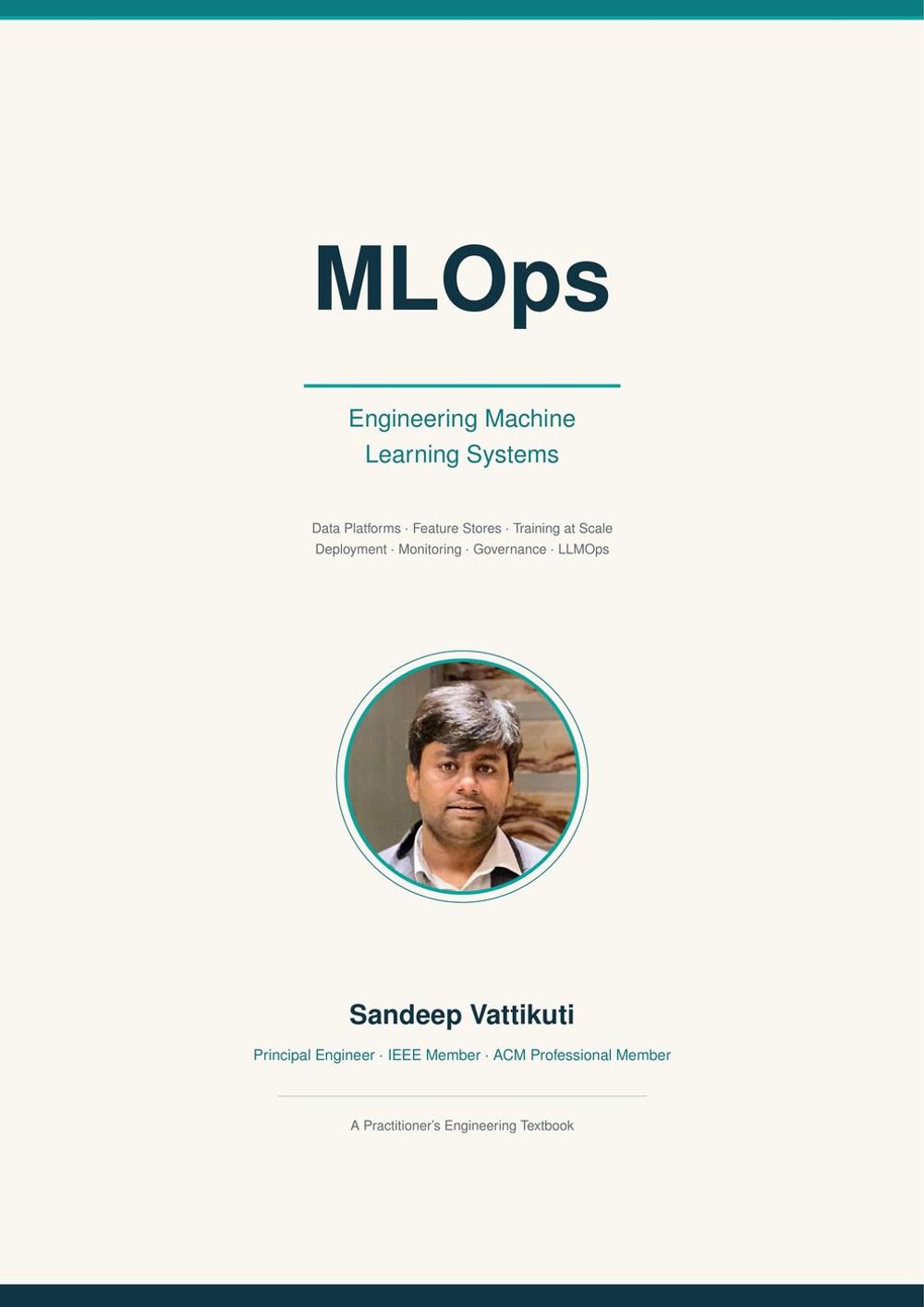
MLOps: Engineering Machine Learning Systems by Sandeep Vattikuti is a practitioner's textbook built on one central observation: a machine learning model is a small artefact surrounded by a large system, and almost all of the engineering effort, and almost all of the failure, lives in that surrounding system rather than in the model itself. Written for data engineers, ML engineers, platform engineers and technical leads, the book treats MLOps as systems engineering rather than a tool or a job title, and organises its ten chapters around the ways production ML systems break and the structures that prevent them. It opens by explaining why ML systems differ from conventional software: their behaviour is specified by data rather than logic, their inputs come from a world nobody controls, and they fail silently instead of loudly, which is why a model can degrade for months before anyone notices. From there it follows the lifecycle as a chain of independently failing subsystems. The data platform chapter covers lakehouse architecture, batch and streaming pipelines, idempotent and replayable pipeline design, and data contracts that turn silent upstream changes into visible failures. The feature chapter tackles training–serving skew and point-in-time correctness, the two problems that motivate feature stores, and explains when building or adopting one is justified. The training chapter argues that an experiment nobody can reproduce is an anecdote and a model nobody can rebuild is a liability, covering experiment tracking, temporal splits, slice analysis, calibration and retraining triggers. Later chapters address packaging and model registries, release strategies such as shadow, canary and blue–green deployment, and rollback as a first-class capability; serving as a queueing and capacity-planning problem governed by latency budgets, batching, model optimisation and unit economics; and monitoring, which the author calls the chapter whose absence causes the most damage, with a four-layer model spanning infrastructure, data, model and business signals, statistical drift tests, the label-delay problem, alert design and incident response. The book then turns to the automation and organisation that keep all of this running, including CI/CD for models, an ML testing pyramid, orchestration, infrastructure as code, internal platform design and team topologies, followed by security, privacy, regulation, fairness, explainability and audit trails. A final chapter on LLMOps identifies what genuinely changes with large language models, from externally owned models and label-free evaluation to per-token cost and retrieval-augmented generation, before consolidating the whole book into a single integrated framework. Each chapter includes learning objectives, worked quantitative examples, original diagrams, a composite case study, key takeaways, and review, numerical, design and research problems, while six appendices supply reference architectures, a metrics and SLO reference, a readiness checklist, operational runbooks, a glossary and a guide to further reading. Throughout, the author holds to two conventions that shape the book's character: every figure is illustrative rather than a measured result from a real organisation, and tooling is discussed by category and capability rather than by brand, so readers learn what a system must guarantee and can evaluate any implementation of it long after specific products have changed.
Leggi di più
Leggi di meno
Autore:
Anno edizione:
2026
Editore:
Formato:
Lingua:
Inglese
Compatibilità:
Tutti i dispositivi (eccetto Kindle) Scopri di più
Layout:
Reflowable
EAN:
9798237972320
L'articolo è stato aggiunto al carrello
Formato:
Gli eBook venduti da IBS.it sono in formato ePub e possono essere protetti da Adobe DRM. In caso di download di un file protetto da DRM si otterrà un file in formato .acs, (Adobe Content Server Message), che dovrà essere aperto tramite Adobe Digital Editions e autorizzato tramite un account Adobe, prima di poter essere letto su pc o trasferito su dispositivi compatibili.
Cloud:
Gli eBook venduti da IBS.it sono sincronizzati automaticamente su tutti i client di lettura Kobo successivamente all’acquisto. Grazie al Cloud Kobo i progressi di lettura, le note, le evidenziazioni vengono salvati e sincronizzati automaticamente su tutti i dispositivi e le APP di lettura Kobo utilizzati per la lettura.
Clicca qui per sapere come scaricare gli ebook utilizzando un pc con sistema operativo Windows
L’articolo è stato aggiunto alla lista dei desideri
