

L’articolo è stato aggiunto alla lista dei desideri









LIBRO VINTAGE
 E-mail
 Facebook
 LinkedIn
 Twitter
 WhatsApp
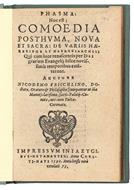
Phasma: / Hoc est; / comoedia / posthuma, nova / et sacra: de variis hae- / resibus et haeresiarchis; / Qui cum luce renascentis per Dei / gratiam Evangelij hisce novis- / simis temporibus exti- / terunt Impressum in Iazygi- / bus-Metanastis, Anno Ch
(0)
Cliccando su “Conferma” dichiari che il contenuto da te inserito è conforme alle Condizioni Generali d’Uso del Sito ed alle Linee Guida sui Contenuti Vietati. Puoi rileggere e modificare e successivamente confermare il tuo contenuto. Tra poche ore lo troverai online (in caso contrario verifica la conformità del contenuto alle policy del Sito).
Grazie per la tua recensione!
Tra poche ore la vedrai online (in caso contrario verifica la conformità del testo alle nostre linee guida). Dopo la pubblicazione per te +4 punti 
Dati e Statistiche
 Salvato in 0 liste dei desideri
Salvato in 0 liste dei desideri
Phasma: / Hoc est; / comoedia / posthuma, nova / et sacra: de variis hae- / resibus et haeresiarchis; / Qui cum luce renascentis per Dei / gratiam Evangelij hisce novis- / simis temporibus exti- / terunt Impressum in Iazygi- / bus-Metanastis, Anno Ch
Disponibilità immediata
900,00 €
900,00 €
Disponibilità immediata
Altre offerte vendute e spedite dai nostri venditori
Libri Vintage
Phasma: / Hoc est; / comoedia / posthuma, nova / et sacra: de variis hae- / resibus et haeresiarchis; / Qui cum luce renascentis per Dei / gratiam Evangelij hisce novis- / simis temporibus exti- / terunt Impressum in Iazygi- / bus-Metanastis, Anno Ch
Altri venditori
Prezzo e spese di spedizione

LIBRO VINTAGE
Condizione accettabile
Disponibilità immediata

Venduto e spedito da
Libreria Alberto Govi
 5/
5
(5 opinioni)
5/
5
(5 opinioni)
Spedizione 5,00 €
900,00 €
Altri venditori
Prezzo e spese di spedizione
Altri venditori
Prezzo e spese di spedizione
LIBRO VINTAGE
Condizione accettabile
Disponibilità immediata
Venduto e spedito da
Libreria Alberto Govi
5/
5
(5 opinioni)
Spedizione 5,00 €
900,00 €

Tutti i formati ed edizioni

Promo attive (0)
8vo (141x90 mm). [64] leaves. Collation: A-H8. Text in Latin, but summaries, two final choirs and epilogue in German verse. Woodcut ornament on the title page. Modern boards. Bookplate Martin Schupp on the title page. Some ancient underlining and annotations. Slightly uniformly browned, margins cut short occasionally affecting the printed marginalia.
Apparently unrecorded variant of the first edition (?) with the misprint “Chriti” instead of “Christi” at the bottom of the title page. The edition was printed in Strassburg by Bernhard Jobin. Several variant issues of this 1592 edition are known, and establishing a chronological order for them is basically impossible. Jobin and his heirs reprinted the work in 1593, 1595 (in Frischlin's collected works) and 1598. It remained popular throughout the 17th century and was also translated into Italian (Augsburg, 1611) and German (Augsburg, 1671).
This comedy, which appeared two years after Frischlin's tragic death while attempting to escape from the Hohenurach fortress, is a seminal work on the religious conflicts of the late 16th century. In it, Frischlin presents various religious movements and sects of his time on stage in a satirical and allegorical manner from a decidedly Lutheran perspective. The work was written amid the bitter confessional conflicts of the late Reformation, particularly the dispute between Lutheran orthodoxy and emerging Calvinism (so-called “crypto-Calvinism”) as well as the Catholic Counter-Reformation.
A ghost (‘phasma') appears in a town, causing turmoil among the citizens. This ghost serves as an allegory for religious aberrations and heresies, as well as the hypocrisy of the various religious factions. Frischlin, a combative Lutheran, attacks everyone. He criticises the Jesuits (Catholicism), the Calvinists (Zwinglians) and the Anabaptists equally. Following the model of ancient comedy (Terence in particular), Frischlin uses satire to ridicule his theological opponents; laughter becomes a weapon in the denominational dispute, while drama becomes a medium for religious propaganda. Controversial theological dogmas (such as the doctrines of the Lord's Supper and predestination) are brought to the stage and presented in a polemical and exaggerated manner to an educated audience of scholars and students. Although Lutheran authorities were often sceptical of theatre due to its potential immorality, Phasma demonstrated how Neo-Latin school drama could be deliberately employed to strengthen confessional identity (cf. D.F. Strauss, Leben und Schriften des Dichters und Philologen Nicodemus Frischlin, Frankfurt a.M., 1856, pp. 125-130; and R.E. Schade, Komödie und Konfession. Eine Dokumentation zu Frischlins ‘Phasma' (1592), in: “Euphorion”, vol. 86.3, 1992, pp. 284-318).
After receiving his early education in Balingen, Königsbronn and Bebenhausen, Nicodemus Frischlin matriculated at Tübingen in 1562. In 1568, he was appointed professor of poetics and history at the university. Following difficulties with his colleagues at the university, he took up the position of head of the Landeschule in Laibach. However, the quarrels resumed when he returned to Tübingen. In 1577, he was crowned ‘poeta laureatus' by Emperor Rudolph II. He then led a nomadic life, travelling to Prague, Wittenberg, Kassel, Marburg, Braunschweig and Frankfurt. Ultimately, he was arrested in Mainz and imprisoned in the Hohenurach fortress. He died while attempting to escape (cf. S.M. Wheels, Publish and perish: on the martyrdom of Philipp Nicodemus Frischlin, in: “Neophilologus”, LVIII, 1974, pp. 41-51; and R.E. Schade, <
Leggi di più
Leggi di meno
Venditore:

Libreria Alberto Govi
Vedi tutti i prodotti
Informazioni:
8vo (141x90 mm). [64] leaves. Collation: A-H8. Text in Latin, but summaries, two final choirs and epilogue in German verse. Woodcut ornament on the title page. Modern boards. Bookplate Martin Schupp on the title page. Some ancient underlining and annotations. Slightly uniformly browned, margins cut short occasionally affecting the printed marginalia. Apparently unrecorded variant of the first edition (?) with the misprint “Chriti” instead of “Christi” at the bottom of the title page. The edition was printed in Strassburg by Bernhard Jobin. Several variant issues of this 1592 edition are known, and establishing a chronological order for them is basically impossible. Jobin and his heirs reprinted the work in 1593, 1595 (in Frischlin's collected works) and 1598. It remained popular throughout the 17th century and was also translated into Italian (Augsburg, 1611) and German (Augsburg, 1671). This comedy, which appeared two years after Frischlin's tragic death while attempting to escape from the Hohenurach fortress, is a seminal work on the religious conflicts of the late 16th century. In it, Frischlin presents various religious movements and sects of his time on stage in a satirical and allegorical manner from a decidedly Lutheran perspective. The work was written amid the bitter confessional conflicts of the late Reformation, particularly the dispute between Lutheran orthodoxy and emerging Calvinism (so-called “crypto-Calvinism”) as well as the Catholic Counter-Reformation. A ghost (‘phasma') appears in a town, causing turmoil among the citizens. This ghost serves as an allegory for religious aberrations and heresies, as well as the hypocrisy of the various religious factions. Frischlin, a combative Lutheran, attacks everyone. He criticises the Jesuits (Catholicism), the Calvinists (Zwinglians) and the Anabaptists equally. Following the model of ancient comedy (Terence in particular), Frischlin uses satire to ridicule his theological opponents; laughter becomes a weapo
Immagini:


- Prodotto usato
- Condizioni: Usato - Condizione accettabile
EAN:
2570270168932

L'articolo è stato aggiunto al carrello
Informazioni e Contatti sulla Sicurezza dei Prodotti
Le schede prodotto sono aggiornate in conformità al Regolamento UE 988/2023. Laddove ci fossero taluni dati non disponibili per ragioni indipendenti da IBS, vi informiamo che stiamo compiendo ogni ragionevole sforzo per inserirli. Vi invitiamo a controllare periodicamente il sito www.ibs.it per eventuali novità e aggiornamenti.
Per le vendite di prodotti da terze parti, ciascun venditore si assume la piena e diretta responsabilità per la commercializzazione del prodotto e per la sua conformità al Regolamento UE 988/2023, nonché alle normative nazionali ed europee vigenti.
Per informazioni sulla sicurezza dei prodotti, contattare productsafetyibs@feltrinelli.it
L’articolo è stato aggiunto alla lista dei desideri
