

L’articolo è stato aggiunto alla lista dei desideri









LIBRO INGLESE
 E-mail
 Facebook
 LinkedIn
 Twitter
 WhatsApp
Protein Modules in Signal Transduction
(0)
Cliccando su “Conferma” dichiari che il contenuto da te inserito è conforme alle Condizioni Generali d’Uso del Sito ed alle Linee Guida sui Contenuti Vietati. Puoi rileggere e modificare e successivamente confermare il tuo contenuto. Tra poche ore lo troverai online (in caso contrario verifica la conformità del contenuto alle policy del Sito).
Grazie per la tua recensione!
Tra poche ore la vedrai online (in caso contrario verifica la conformità del testo alle nostre linee guida). Dopo la pubblicazione per te +4 punti 
136,60 €
+1370
punti 
Venditore: IBS
Articolo acquistabile con Carta del Docente

Articolo acquistabile con Carta Cultura Giovani e Carta del Merito

Articolo acquistabile con Carta della Cultura

Paga con Klarna in 3 rate senza interessi per ordini superiori a 39 €

Dati e Statistiche
 Salvato in 0 liste dei desideri
Salvato in 0 liste dei desideri
Protein Modules in Signal Transduction
Disponibilità in 2 settimane
136,60 €
136,60 €
Disponibilità in 2 settimane
Altre offerte vendute e spedite dai nostri venditori

Libri in Inglese
Protein Modules in Signal Transduction
Altri venditori
Prezzo e spese di spedizione
LIBRO INGLESE
Disponibilità in 2 settimane

Venduto e spedito da
IBS
Spedizione Gratis
136,60 €
Altri venditori
Prezzo e spese di spedizione
LIBRO INGLESE
Disponibilità in 2 settimane
Venduto e spedito da
IBS
Spedizione Gratis
136,60 €
Altri venditori
Prezzo e spese di spedizione

Tutti i formati ed edizioni

Promo attive (0)
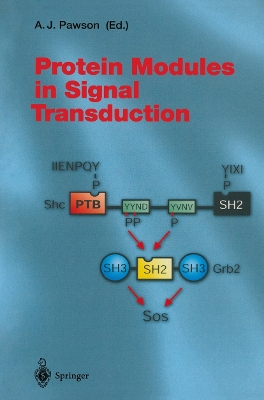
The behavior of eukaryotic cells, particularly those of multicel- lular organisms, depends on the transmission of signals from one cell to another. Such extracellular signals can take the form of hormones, antigens, cells surface molecules, or components of the extracellular matrix and exert their effects by binding to specific receptors, usually exposed on the surface of the target cell. These transmembrane receptors possess a cytoplasmic domain that al- lows communication with intracellular signaling pathways, pro- viding access to the regulation of gene expression, cytoskeletal architecture, cell metabolism, survival, and the cell cycle. Defining the process through which a signal emanating from an individual receptor can influence so many aspects of cellular function is of central importance for our understanding of signal transduction. Many polypeptide factors that regulate cellular growth and differentiation bind to receptors with cytoplasmic tyrosine kinase domains. Recent evidence has indicated that intracellular sig- naling from receptor tyrosine kinases proceeds through a series of modular protein-protein interactions, typified by the interaction of autophosphorylated growth factor receptors with the Src ho- mology 2 (SH2) domains of cytoplasmic target proteins. Thus, a crucial role of tyrosine phosphorylation is to promote the for- mation of protein complexes through the creation of specific SH2 domain-binding sites, thereby regulating the activation of bio- chemical pathways within the cell.
Leggi di più
Leggi di meno
Curatore:
Collana:
Current Topics in Microbiology and Immunology
Anno:
2011
Rilegatura:
Paperback / softback
Pagine:
368 p.
Testo in English
Dimensioni:
235 x 155 mm
EAN:
9783642804830

L'articolo è stato aggiunto al carrello
Informazioni e Contatti sulla Sicurezza dei Prodotti
Le schede prodotto sono aggiornate in conformità al Regolamento UE 988/2023. Laddove ci fossero taluni dati non disponibili per ragioni indipendenti da IBS, vi informiamo che stiamo compiendo ogni ragionevole sforzo per inserirli. Vi invitiamo a controllare periodicamente il sito www.ibs.it per eventuali novità e aggiornamenti.
Per le vendite di prodotti da terze parti, ciascun venditore si assume la piena e diretta responsabilità per la commercializzazione del prodotto e per la sua conformità al Regolamento UE 988/2023, nonché alle normative nazionali ed europee vigenti.
Per informazioni sulla sicurezza dei prodotti, contattare productsafetyibs@feltrinelli.it
L’articolo è stato aggiunto alla lista dei desideri
