

L’articolo è stato aggiunto alla lista dei desideri








EBOOK IN LINGUA STRANIERA
 E-mail
 Facebook
 LinkedIn
 Twitter
 WhatsApp
Robotics Goes MOOC
(0)
Cliccando su “Conferma” dichiari che il contenuto da te inserito è conforme alle Condizioni Generali d’Uso del Sito ed alle Linee Guida sui Contenuti Vietati. Puoi rileggere e modificare e successivamente confermare il tuo contenuto. Tra poche ore lo troverai online (in caso contrario verifica la conformità del contenuto alle policy del Sito).
Grazie per la tua recensione!
Tra poche ore la vedrai online (in caso contrario verifica la conformità del testo alle nostre linee guida). Dopo la pubblicazione per te +4 punti 
51,47 €
+510
punti 
Venditore: IBS

Acquista online
Scaricabile subito
Articolo acquistabile con Carta del Docente

Articolo acquistabile con Carta Cultura Giovani e Carta del Merito

Articolo acquistabile con Carta della Cultura

Dati e Statistiche
 Salvato in 0 liste dei desideri
Salvato in 0 liste dei desideri
Robotics Goes MOOC
Scaricabile subito
51,47 €
51,47 €
Scaricabile subito
Altre offerte vendute e spedite dai nostri venditori
Ebook in lingua straniera
Robotics Goes MOOC
Altri venditori
Prezzo e spese di spedizione
EBOOK INGLESE
EPUB3 con Adobe DRM
Scaricabile subito

Venduto e spedito da
IBS
Spedizione Gratis
51,47 €
Altri venditori
Prezzo e spese di spedizione
EBOOK INGLESE
EPUB3 con Adobe DRM
Scaricabile subito
Venduto e spedito da
IBS
Spedizione Gratis
51,47 €
Altri venditori
Prezzo e spese di spedizione

Tutti i formati ed edizioni
Promo attive (0)
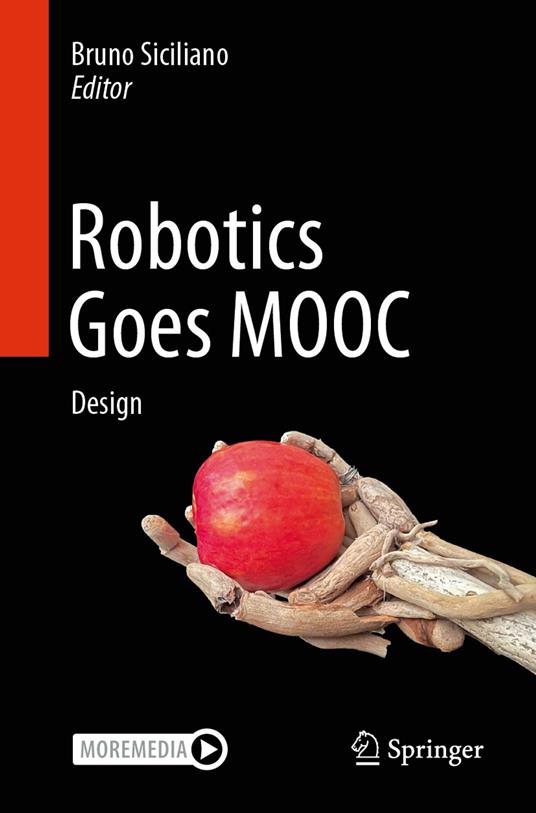
A robot’s appearance and its way of interacting with humans is of fundamental importance. Until a few years ago there was a clear asymmetry between the typically excellent performance of industrial robots and their ugly and disharmonious bodies, with crude ways and potentially very dangerous movements for the human environment. A modern artifact can be as harmonious and beautiful as a complex biological machine or a work of plastic art and thus it should be clear how design plays a key role for robot technology to become a part of our everyday life and change it essentially in a responsible and beneficial manner. It is designers who shape the interface between humans and machines and, as such, they will contribute to make robots as customizable and intuitively useful to inexperienced users according to a plug-and-play mode. The new concept of robotronics as the mechatronics approach to designing advanced robots is the focus of the first chapter of the second book of the Robotics Goes MOOC project by Asfour et al. The main issues for robot manipulator design are covered in the subsequent material, namely redundant robots in Chapter 2 by Maciejewsky et al and parallel robots in Chapter 3 by Müller, where widely adopted kinematic solutions are presented. Then, the adoption to flexibilty, as opposed to the rigid mechanics paradigm, is discussed in Chapter 4 by Bertram et al with reference to elastic robots and in Chapter 5 by Laschi focused on soft robotics. Somewhat speculating on the previous two design solutions comes Chapter 6 by Cutkosky dealing with bioinspired robots. The last part of the book is devoted to robot locomotion, namely, Chapter 7 by Vendittelli on wheeled robots and Chapter 8 by Harada on (biped) humanoids.
Leggi di più
Leggi di meno
Lingua:
Inglese
Compatibilità:
Tutti i dispositivi (eccetto Kindle) Scopri di più
Layout:
Reflowable
EAN:
9783319758237
L'articolo è stato aggiunto al carrello
Formato:
Gli eBook venduti da IBS.it sono in formato ePub e possono essere protetti da Adobe DRM. In caso di download di un file protetto da DRM si otterrà un file in formato .acs, (Adobe Content Server Message), che dovrà essere aperto tramite Adobe Digital Editions e autorizzato tramite un account Adobe, prima di poter essere letto su pc o trasferito su dispositivi compatibili.
Cloud:
Gli eBook venduti da IBS.it sono sincronizzati automaticamente su tutti i client di lettura Kobo successivamente all’acquisto. Grazie al Cloud Kobo i progressi di lettura, le note, le evidenziazioni vengono salvati e sincronizzati automaticamente su tutti i dispositivi e le APP di lettura Kobo utilizzati per la lettura.
Clicca qui per sapere come scaricare gli ebook utilizzando un pc con sistema operativo Windows
L’articolo è stato aggiunto alla lista dei desideri
