

L’articolo è stato aggiunto alla lista dei desideri








LIBRO INGLESE
 E-mail
 Facebook
 LinkedIn
 Twitter
 WhatsApp
Stabilization & Modification of Cellulose Diacetate
(0)
Cliccando su “Conferma” dichiari che il contenuto da te inserito è conforme alle Condizioni Generali d’Uso del Sito ed alle Linee Guida sui Contenuti Vietati. Puoi rileggere e modificare e successivamente confermare il tuo contenuto. Tra poche ore lo troverai online (in caso contrario verifica la conformità del contenuto alle policy del Sito).
Grazie per la tua recensione!
Tra poche ore la vedrai online (in caso contrario verifica la conformità del testo alle nostre linee guida). Dopo la pubblicazione per te +4 punti 
66,24 €
+660
punti 
Prezzo minimo ultimi 30 giorni: 62,93 €
Venditore: IBS
Articolo acquistabile con Carta del Docente

Articolo acquistabile con Carta Cultura Giovani e Carta del Merito

Articolo acquistabile con Carta della Cultura

Paga con Klarna in 3 rate senza interessi per ordini superiori a 39 €

Dati e Statistiche
 Salvato in 0 liste dei desideri
Salvato in 0 liste dei desideri
Stabilization & Modification of Cellulose Diacetate
Attualmente non disponibile
66,24 €
66,24 €
Attualmente non disponibile
Altre offerte vendute e spedite dai nostri venditori
Libri in Inglese
Stabilization & Modification of Cellulose Diacetate
Altri venditori
Prezzo e spese di spedizione
LIBRO INGLESE
Attualmente non disponibile

Venduto e spedito da
IBS
Spedizione Gratis
66,24 €
Altri venditori
Prezzo e spese di spedizione
LIBRO INGLESE
Attualmente non disponibile
Venduto e spedito da
IBS
Spedizione Gratis
66,24 €
Altri venditori
Prezzo e spese di spedizione

Tutti i formati ed edizioni
Promo attive (0)
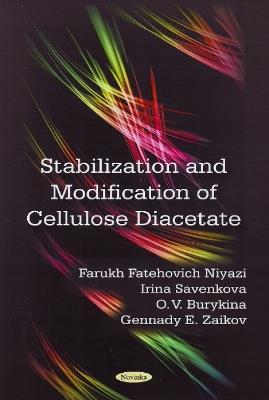
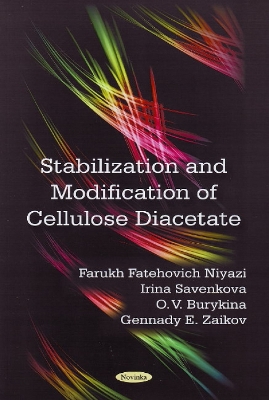
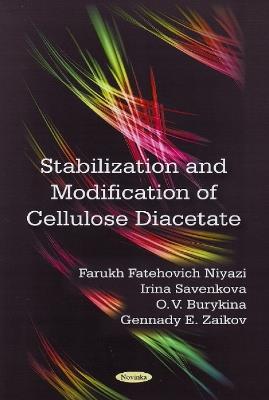
Cellulose and its derivatives -- cellulose acetate -- are renewed polymers, that, together with the whole complex of valuable and indispensable properties, defines continuous growth of their production. Acetate fibres differ from cellulose fibres in light and thermooxidative stability, as the presence of ester groups decreases stability of molecular structure, owing to which destructive processes begin at much lower temperatures and weak energy effects. Since macromolecules of cellulose acetate are constructed on the basis of cellulose then mechanism of photodestruction of these polymers may be considered as general. The most important energetic factor, which photodestruction of cellulose and its derivatives depend on, is intensity of irradiation and wave length. Destruction of cellulose and its derivatives under atmospheric conditions, proceeding as a result of photochemical reaction, on the whole takes place under the action of ultraviolet rays with ?=200-360 nm. Since cellulose contains three types of chromophore groups -- hydroxyl, acetate and semiacetate and also aldehyde -- then it is considered that light absorption in the region of 250-300 nm is caused just by them. At the same time some authors, bringing the possibility of light absorption by acetal chromophore in question, have put forward the supposition that photochemically active centres in cellulose materials, containing carboxyl and hydroxyl groups, may be molecular complexes between these groups, connected by the system of hydrogen bounds with definite energy of interaction. Disproportion of intermolecular bonds, providing fixation of excited state in cellulose matrix takes place in such complexes at their excitation. Thus, there are many different hypotheses, often contradicting each other, about the effect of chromophore groups on light absorption by cellulose. There are many data about the nature of free-radical particles, being formed at irradiation of cellulose by ultraviolet light. Since, being formed products of phototransformation are highly mobile and easily undergo further transformations, method of electron-paramagnetic resonance (ESP) is one of the most effective for these particles identification. Critical analysis of a great number of works on EPR spectra interpretation is quite fully given in surveys. More than 20 different radicals are being formed at ultraviolet irradiation as a result of break of practically all bonds C-C; C-H; C-O. Main types of macroradicals, with indication of atom and groups of atoms after removal of which these macroradicals are formed, are presented in scheme 1. of this book.
Leggi di più
Leggi di meno
Editore:
Anno:
2009
Rilegatura:
Paperback / softback
Pagine:
82 p.
Testo in English
Dimensioni:
155 x 230 mm
Peso:
164 gr.
EAN:
9781606920022

L'articolo è stato aggiunto al carrello
Informazioni e Contatti sulla Sicurezza dei Prodotti
Le schede prodotto sono aggiornate in conformità al Regolamento UE 988/2023. Laddove ci fossero taluni dati non disponibili per ragioni indipendenti da IBS, vi informiamo che stiamo compiendo ogni ragionevole sforzo per inserirli. Vi invitiamo a controllare periodicamente il sito www.ibs.it per eventuali novità e aggiornamenti.
Per le vendite di prodotti da terze parti, ciascun venditore si assume la piena e diretta responsabilità per la commercializzazione del prodotto e per la sua conformità al Regolamento UE 988/2023, nonché alle normative nazionali ed europee vigenti.
Per informazioni sulla sicurezza dei prodotti, contattare productsafetyibs@feltrinelli.it
L’articolo è stato aggiunto alla lista dei desideri
