

L’articolo è stato aggiunto alla lista dei desideri








LIBRO INGLESE
 E-mail
 Facebook
 LinkedIn
 Twitter
 WhatsApp
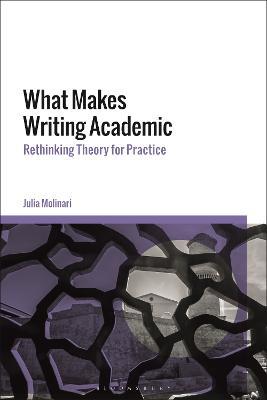
What Makes Writing Academic: Rethinking Theory for Practice
(0)
Cliccando su “Conferma” dichiari che il contenuto da te inserito è conforme alle Condizioni Generali d’Uso del Sito ed alle Linee Guida sui Contenuti Vietati. Puoi rileggere e modificare e successivamente confermare il tuo contenuto. Tra poche ore lo troverai online (in caso contrario verifica la conformità del contenuto alle policy del Sito).
Grazie per la tua recensione!
Tra poche ore la vedrai online (in caso contrario verifica la conformità del testo alle nostre linee guida). Dopo la pubblicazione per te +4 punti 
53,40 €
+530
punti 
Venditore: IBS
Articolo acquistabile con Carta del Docente

Articolo acquistabile con Carta Cultura Giovani e Carta del Merito

Articolo acquistabile con Carta della Cultura

Paga con Klarna in 3 rate senza interessi per ordini superiori a 39 €

Dati e Statistiche
 Salvato in 0 liste dei desideri
Salvato in 0 liste dei desideri
What Makes Writing Academic: Rethinking Theory for Practice
Disponibilità in 2 settimane
53,40 €
53,40 €
Disponibilità in 2 settimane
Altre offerte vendute e spedite dai nostri venditori

Libri in Inglese
What Makes Writing Academic: Rethinking Theory for Practice
Altri venditori
Prezzo e spese di spedizione
LIBRO INGLESE
Disponibilità in 2 settimane

Venduto e spedito da
IBS
Spedizione Gratis
53,40 €
Altri venditori
Prezzo e spese di spedizione
LIBRO INGLESE
Disponibilità in 2 settimane
Venduto e spedito da
IBS
Spedizione Gratis
53,40 €
Altri venditori
Prezzo e spese di spedizione

Tutti i formati ed edizioni
Promo attive (0)
This open access book argues that what makes writing academic emerges from socio-academic and historical practices rather than conventionalised stylistic, linguistic or syntactic forms. Using a critical realist lens, it re-imagines academic writings as 21st-century open systems that change according to affordances perceived by writers. By re-imagining how, which and whose knowledge emerges, conceptual spaces are created whereby writing practices can be pluralised and democratised. Academic communication hinges on being able to write in certain forms but not others, which risks excluding knowledge that may lend itself to alternative forms of representation, such as dialogues, chronicles, manifestos, blogs, poems and comics. Moreover, because academic ability tends to be misleadingly conflated with writing ability, limiting how the academy writes to a relatively narrow set of forms (such as the traditional essay or thesis) may be preventing a range of abilities from emerging. Standardised forms require abstracts, introductions, main bodies and conclusions that are also predominantly monolingual and monomodal: this can narrow, distort, constrain or flatten epistemic representation, leading to a range of epistemic losses (as well as gains). Based on examples from a range of academic writers, including students, and drawing on the history of academia, philosophy, socio-semiotic research, integrational and sociolinguistics as well as studies in multimodal and visual thinking, the book proposes that academic writings be re-imagined as multimodal artefacts that allow a wider range of epistemic affordances to emerge. The ebook editions of this book are available open access under a CC BY-NC-ND 4.0 licence on bloomsburycollections.com. Open access was funded by Knowledge Unlatched.
Leggi di più
Leggi di meno
Autore:
Editore:
Anno:
2023
Rilegatura:
Paperback / softback
Pagine:
224 p.
Testo in English
Dimensioni:
234 x 156 mm
EAN:
9781350243965

L'articolo è stato aggiunto al carrello
Informazioni e Contatti sulla Sicurezza dei Prodotti
Le schede prodotto sono aggiornate in conformità al Regolamento UE 988/2023. Laddove ci fossero taluni dati non disponibili per ragioni indipendenti da IBS, vi informiamo che stiamo compiendo ogni ragionevole sforzo per inserirli. Vi invitiamo a controllare periodicamente il sito www.ibs.it per eventuali novità e aggiornamenti.
Per le vendite di prodotti da terze parti, ciascun venditore si assume la piena e diretta responsabilità per la commercializzazione del prodotto e per la sua conformità al Regolamento UE 988/2023, nonché alle normative nazionali ed europee vigenti.
Per informazioni sulla sicurezza dei prodotti, contattare productsafetyibs@feltrinelli.it
L’articolo è stato aggiunto alla lista dei desideri
