

L’articolo è stato aggiunto alla lista dei desideri








LIBRO INGLESE
 E-mail
 Facebook
 LinkedIn
 Twitter
 WhatsApp
Antiterrorist Emergency Ventilation: System, Strategy & Decision-Making
(0)
Cliccando su “Conferma” dichiari che il contenuto da te inserito è conforme alle Condizioni Generali d’Uso del Sito ed alle Linee Guida sui Contenuti Vietati. Puoi rileggere e modificare e successivamente confermare il tuo contenuto. Tra poche ore lo troverai online (in caso contrario verifica la conformità del contenuto alle policy del Sito).
Grazie per la tua recensione!
Tra poche ore la vedrai online (in caso contrario verifica la conformità del testo alle nostre linee guida). Dopo la pubblicazione per te +4 punti 
66,24 €
+660
punti 
Prezzo minimo ultimi 30 giorni: 62,93 €
Venditore: IBS
Articolo acquistabile con Carta del Docente

Articolo acquistabile con Carta Cultura Giovani e Carta del Merito

Articolo acquistabile con Carta della Cultura

Paga con Klarna in 3 rate senza interessi per ordini superiori a 39 €

Dati e Statistiche
 Salvato in 0 liste dei desideri
Salvato in 0 liste dei desideri
Antiterrorist Emergency Ventilation: System, Strategy & Decision-Making
Attualmente non disponibile
66,24 €
66,24 €
Attualmente non disponibile
Altre offerte vendute e spedite dai nostri venditori
Libri in Inglese
Antiterrorist Emergency Ventilation: System, Strategy & Decision-Making
Altri venditori
Prezzo e spese di spedizione
LIBRO INGLESE
Attualmente non disponibile

Venduto e spedito da
IBS
Spedizione Gratis
66,24 €
Altri venditori
Prezzo e spese di spedizione
LIBRO INGLESE
Attualmente non disponibile
Venduto e spedito da
IBS
Spedizione Gratis
66,24 €
Altri venditori
Prezzo e spese di spedizione

Tutti i formati ed edizioni
Promo attive (0)
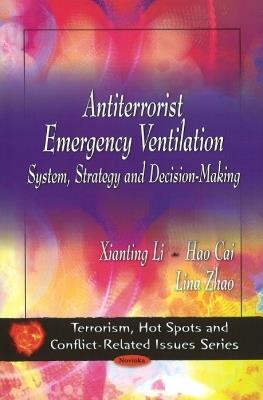
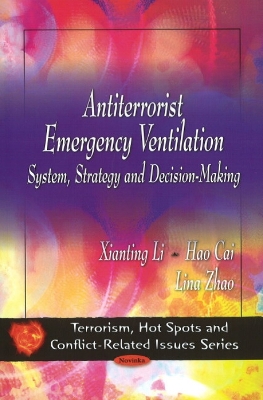
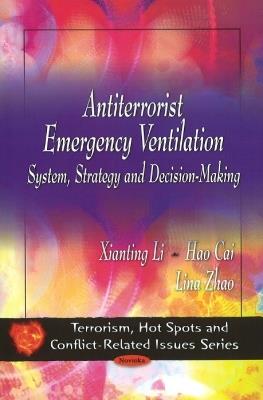
There are two kinds of antiterrorist emergency ventilation system. One is to defend indoor environment against chemical and biological agent (CBA) attacks. The other is to supply calmative gas to incapacitate terrorists when they hold hostages in public buildings. What kind of system and ventilation strategy can be used for antiterrorism, and how to make decision are introduced in the book. There are six sections in the book. How the emergency ventilation systems work is introduced in the first section. The second section is on the theory of contaminant dispersion and identification of contaminant source. For the theory of contaminant dispersion, both computational fluid dynamics (CFD) method and analytical formula of contaminant distribution are introduced. For the theory of contaminant source identification, an algorithm to identify the position and intensity of contaminant source with limited number of sensors is proposed and demonstrated for its effectiveness. The third section is on the evacuation model and evaluation of exposure risk. Both cellular automata (CA) model and spatial-grid evacuation model (SGEM) are introduced for modelling evacuation process. The relative exposure risk index, EFCS, and absolute exposure risk index, PIR, are introduced to evaluate the exposure risk of contaminant. Both the second section and third section are the fundamental of emergency ventilation. Based on section 2 and 3, the ventilation strategy and decision-making are introduced for emergency ventilation against contaminant suddenly released in public building in section 4 and for emergency ventilation to rescue hostages held by terrorists in section 5, respectively. Section 6 is the summary of the whole book.
Leggi di più
Leggi di meno
Autore:
Editore:
Anno:
2009
Rilegatura:
Paperback / softback
Pagine:
95 p.
Testo in English
Dimensioni:
155 x 230 mm
Peso:
194 gr.
EAN:
9781607410416

L'articolo è stato aggiunto al carrello
Informazioni e Contatti sulla Sicurezza dei Prodotti
Le schede prodotto sono aggiornate in conformità al Regolamento UE 988/2023. Laddove ci fossero taluni dati non disponibili per ragioni indipendenti da IBS, vi informiamo che stiamo compiendo ogni ragionevole sforzo per inserirli. Vi invitiamo a controllare periodicamente il sito www.ibs.it per eventuali novità e aggiornamenti.
Per le vendite di prodotti da terze parti, ciascun venditore si assume la piena e diretta responsabilità per la commercializzazione del prodotto e per la sua conformità al Regolamento UE 988/2023, nonché alle normative nazionali ed europee vigenti.
Per informazioni sulla sicurezza dei prodotti, contattare productsafetyibs@feltrinelli.it
L’articolo è stato aggiunto alla lista dei desideri
