

L’articolo è stato aggiunto alla lista dei desideri






LIBRO INGLESE
 E-mail
 Facebook
 LinkedIn
 Twitter
 WhatsApp
The Architecture of Rome
(0)
Cliccando su “Conferma” dichiari che il contenuto da te inserito è conforme alle Condizioni Generali d’Uso del Sito ed alle Linee Guida sui Contenuti Vietati. Puoi rileggere e modificare e successivamente confermare il tuo contenuto. Tra poche ore lo troverai online (in caso contrario verifica la conformità del contenuto alle policy del Sito).
Grazie per la tua recensione!
Tra poche ore la vedrai online (in caso contrario verifica la conformità del testo alle nostre linee guida). Dopo la pubblicazione per te +4 punti 
46,02 €

Prezzo minimo ultimi 30 giorni: 42,49 €
Venditore: IBS
Articolo acquistabile con Carta del Docente

Articolo acquistabile con Carta Cultura Giovani e Carta del Merito

Articolo acquistabile con Carta della Cultura

Paga con Klarna in 3 rate senza interessi per ordini superiori a 39 €

Dati e Statistiche
 Salvato in 0 liste dei desideri
Salvato in 0 liste dei desideri
The Architecture of Rome
Disponibilità in 3 settimane
46,02 €
46,02 €
Disponibilità in 3 settimane
Altre offerte vendute e spedite dai nostri venditori
Libri in Inglese
The Architecture of Rome
Altri venditori
Prezzo e spese di spedizione
LIBRO INGLESE
Disponibilità in 3 settimane

Venduto e spedito da
IBS
Spedizione Gratis
46,02 €
Altri venditori
Prezzo e spese di spedizione
LIBRO INGLESE
Disponibilità in 3 settimane
Venduto e spedito da
IBS
Spedizione Gratis
46,02 €
Altri venditori
Prezzo e spese di spedizione

Tutti i formati ed edizioni
Promo attive (0)
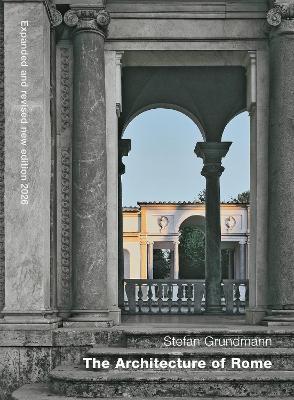
Architects and artists have always acknowledged over the centuries that Rome is rightly called the »eternal city«. Rome is eternal above all because it was always young, always »in its prime«. Here the buildings that defined the West appeared over more than 2000 years, here the history of European architecture was written. The foundations were laid even in ancient Roman times, when the first attempts were made to design interiors and thus make space open to experience as something physical. And at that time the Roman architects also started to develop building types that are still valid today, thus creating the cornerstone of later Western architecture. In it Rome’s primacy remained unbro- ken – whether it was with old St. Peter’s as the first medieval basilica or new St. Peter’s as the building in which Bramante and Michelangelo developed the High Renaissance, or with works by Bernini and Borromini whose rich and lucid spatial forms were to shape Baroque as far as Vienna, Bohemia and Lower Franconia, and also with Modern buildings, of which there are many unexpected pearls to be found in Rome. All this is comprehensible only if it is presented historically, i. e. in chronological sequence, and so the guide has not been arranged topographically as usual but chronologically. This means that one is not led in random sequence from a Baroque building to an ancient or a modern one, but the historical development is followed successively. Every epoch is preceded by an introduction that identifies its key features. This produces a continuous, lavishly illustrated history of the architecture of Rome – and thus at the same time of the whole of the West. Practical handling is guaranteed by an alphabetical index and detailed maps, whose information does not just immediately illustrate the historical picture, but also makes it possible to choose a personal route through history.
Leggi di più
Leggi di meno
Curatore:
Editore:
Anno:
2026
Rilegatura:
Paperback / softback
Pagine:
396 p.
Testo in English
Dimensioni:
222 x 162 mm
Peso:
900 gr.
EAN:
9783869050454

L'articolo è stato aggiunto al carrello
Informazioni e Contatti sulla Sicurezza dei Prodotti
Le schede prodotto sono aggiornate in conformità al Regolamento UE 988/2023. Laddove ci fossero taluni dati non disponibili per ragioni indipendenti da IBS, vi informiamo che stiamo compiendo ogni ragionevole sforzo per inserirli. Vi invitiamo a controllare periodicamente il sito www.ibs.it per eventuali novità e aggiornamenti.
Per le vendite di prodotti da terze parti, ciascun venditore si assume la piena e diretta responsabilità per la commercializzazione del prodotto e per la sua conformità al Regolamento UE 988/2023, nonché alle normative nazionali ed europee vigenti.
Per informazioni sulla sicurezza dei prodotti, contattare productsafetyibs@feltrinelli.it
L’articolo è stato aggiunto alla lista dei desideri
