

L’articolo è stato aggiunto alla lista dei desideri









LIBRO INGLESE
 E-mail
 Facebook
 LinkedIn
 Twitter
 WhatsApp
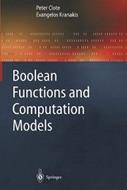
Boolean Functions and Computation Models
(0)
Cliccando su “Conferma” dichiari che il contenuto da te inserito è conforme alle Condizioni Generali d’Uso del Sito ed alle Linee Guida sui Contenuti Vietati. Puoi rileggere e modificare e successivamente confermare il tuo contenuto. Tra poche ore lo troverai online (in caso contrario verifica la conformità del contenuto alle policy del Sito).
Grazie per la tua recensione!
Tra poche ore la vedrai online (in caso contrario verifica la conformità del testo alle nostre linee guida). Dopo la pubblicazione per te +4 punti 
134,00 €
+1340
punti 
Venditore: IBS
Articolo acquistabile con Carta del Docente

Articolo acquistabile con Carta Cultura Giovani e Carta del Merito

Articolo acquistabile con Carta della Cultura

Paga con Klarna in 3 rate senza interessi per ordini superiori a 39 €

Dati e Statistiche
 Salvato in 0 liste dei desideri
Salvato in 0 liste dei desideri
Boolean Functions and Computation Models
Attualmente non disponibile
134,00 €
134,00 €
Attualmente non disponibile
Altre offerte vendute e spedite dai nostri venditori
Libri in Inglese
Boolean Functions and Computation Models
Altri venditori
Prezzo e spese di spedizione

LIBRO INGLESE
Attualmente non disponibile

Venduto e spedito da
IBS
Spedizione Gratis
134,00 €
Altri venditori
Prezzo e spese di spedizione
LIBRO INGLESE
Attualmente non disponibile
Venduto e spedito da
IBS
Spedizione Gratis
134,00 €
Altri venditori
Prezzo e spese di spedizione

Tutti i formati ed edizioni

Promo attive (0)
The foundations of computational complexity theory go back to Alan Thring in the 1930s who was concerned with the existence of automatic procedures deciding the validity of mathematical statements. The first example of such a problem was the undecidability of the Halting Problem which is essentially the question of debugging a computer program: Will a given program eventu ally halt? Computational complexity today addresses the quantitative aspects of the solutions obtained: Is the problem to be solved tractable? But how does one measure the intractability of computation? Several ideas were proposed: A. Cobham [Cob65] raised the question of what is the right model in order to measure a "computation step" , M. Rabin [Rab60] proposed the introduction of axioms that a complexity measure should satisfy, and C. Shannon [Sha49] suggested the boolean circuit that computes a boolean function. However, an important question remains: What is the nature of computa tion? In 1957, John von Neumann [vN58] wrote in his notes for the Silliman Lectures concerning the nature of computation and the human brain that . . . logics and statistics should be primarily, although not exclusively, viewed as the basic tools of 'information theory'. Also, that body of experience which has grown up around the planning, evaluating, and coding of complicated logical and mathematical automata will be the focus of much of this information theory. The most typical, but not the only, such automata are, of course, the large electronic computing machines.
Leggi di più
Leggi di meno
Autore:
Collana:
Texts in Theoretical Computer Science. An EATCS Series
Anno:
2010
Rilegatura:
Paperback / softback
Pagine:
602 p.
Testo in English
Dimensioni:
235 x 155 mm
EAN:
9783642082177

L'articolo è stato aggiunto al carrello
Informazioni e Contatti sulla Sicurezza dei Prodotti
Le schede prodotto sono aggiornate in conformità al Regolamento UE 988/2023. Laddove ci fossero taluni dati non disponibili per ragioni indipendenti da IBS, vi informiamo che stiamo compiendo ogni ragionevole sforzo per inserirli. Vi invitiamo a controllare periodicamente il sito www.ibs.it per eventuali novità e aggiornamenti.
Per le vendite di prodotti da terze parti, ciascun venditore si assume la piena e diretta responsabilità per la commercializzazione del prodotto e per la sua conformità al Regolamento UE 988/2023, nonché alle normative nazionali ed europee vigenti.
Per informazioni sulla sicurezza dei prodotti, contattare productsafetyibs@feltrinelli.it
L’articolo è stato aggiunto alla lista dei desideri
