

L’articolo è stato aggiunto alla lista dei desideri








LIBRO INGLESE
 E-mail
 Facebook
 LinkedIn
 Twitter
 WhatsApp
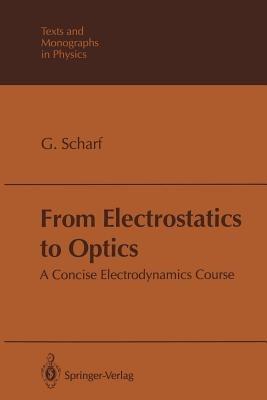
From Electrostatics to Optics: A Concise Electrodynamics Course
(0)
Cliccando su “Conferma” dichiari che il contenuto da te inserito è conforme alle Condizioni Generali d’Uso del Sito ed alle Linee Guida sui Contenuti Vietati. Puoi rileggere e modificare e successivamente confermare il tuo contenuto. Tra poche ore lo troverai online (in caso contrario verifica la conformità del contenuto alle policy del Sito).
Grazie per la tua recensione!
Tra poche ore la vedrai online (in caso contrario verifica la conformità del testo alle nostre linee guida). Dopo la pubblicazione per te +4 punti 

68,30 €
+680
punti 
Venditore: IBS
Articolo acquistabile con Carta del Docente

Articolo acquistabile con Carta Cultura Giovani e Carta del Merito

Articolo acquistabile con Carta della Cultura

Paga con Klarna in 3 rate senza interessi per ordini superiori a 39 €

Dati e Statistiche
 Salvato in 0 liste dei desideri
Salvato in 0 liste dei desideri
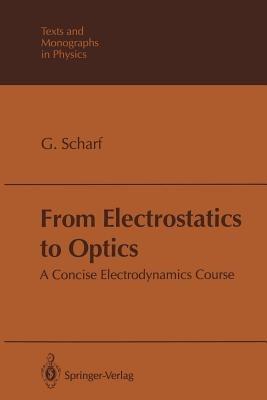
From Electrostatics to Optics: A Concise Electrodynamics Course
Disponibilità in 2 settimane
68,30 €
68,30 €
Disponibilità in 2 settimane
Altre offerte vendute e spedite dai nostri venditori
Libri in Inglese
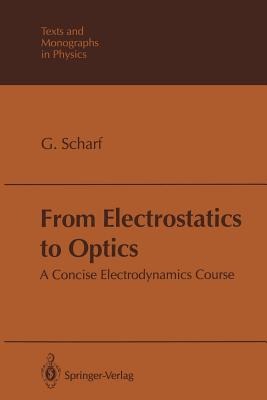
From Electrostatics to Optics: A Concise Electrodynamics Course
Altri venditori
Prezzo e spese di spedizione
Nuovo
Disponibilità in 2 settimane

Venduto e spedito da
IBS
Spedizione Gratis
68,30 €
Altri venditori
Prezzo e spese di spedizione
Nuovo
Disponibilità in 2 settimane
Venduto e spedito da
IBS
Spedizione Gratis
68,30 €
Altri venditori
Prezzo e spese di spedizione

Tutti i formati ed edizioni
Promo attive (1)
We live in the electronic age. Millions of people stare at television sets; com puters penetrate our working life; and the heartbeat of many older people is regulated by a pace-maker. Even music is becoming electric. The good old mechanical Swiss watch has meanwhile been replaced by an electronic watch made in Hong Kong, which is ten times as accurate and costs a tenth of the price. (The cheap Swiss watches are today also electric and the parts are probably made in Hong Kong. ) In physics, the retirement of mechanics as the basis of science already took place in the 19th century, when it was found that light and electromag netism must be described by a field theory and not by a mechanical theory. That was a radically new idea: The basic objects in Newton's mechanics are point particles with coordinates qi(t) and momenta Pi(t) depending on time. If the index i runs from 1 to f, the system has finitely many (f or 2f) degrees of freedom. The basic quantities of field theory, on the otl1. er hand, are a few vector fields E(t,x), B(t,x), v(t,x) which depend on ti~e and space. The velocity field v( t, x) is fundamental in continuum mechan ics, which is certainly a field theory like electrodynamics, not a mechanical 3 particle theory. Since at every place x in lR. the fields at a given time are free to take on values, the system has infinitely many degrees of freedom.
Leggi di più
Leggi di meno
Autore:
Collana:
Theoretical and Mathematical Physics
Anno:
2012
Rilegatura:
Paperback / softback
Pagine:
255 p.
Testo in English
Dimensioni:
235 x 155 mm
EAN:
9783642850899

L'articolo è stato aggiunto al carrello
Informazioni e Contatti sulla Sicurezza dei Prodotti
Le schede prodotto sono aggiornate in conformità al Regolamento UE 988/2023. Laddove ci fossero taluni dati non disponibili per ragioni indipendenti da IBS, vi informiamo che stiamo compiendo ogni ragionevole sforzo per inserirli. Vi invitiamo a controllare periodicamente il sito www.ibs.it per eventuali novità e aggiornamenti.
Per le vendite di prodotti da terze parti, ciascun venditore si assume la piena e diretta responsabilità per la commercializzazione del prodotto e per la sua conformità al Regolamento UE 988/2023, nonché alle normative nazionali ed europee vigenti.
Per informazioni sulla sicurezza dei prodotti, contattare productsafetyibs@feltrinelli.it
L’articolo è stato aggiunto alla lista dei desideri
