

L’articolo è stato aggiunto alla lista dei desideri









EBOOK IN LINGUA STRANIERA
 E-mail
 Facebook
 LinkedIn
 Twitter
 WhatsApp
THE QUIET CHILD
(0)
Cliccando su “Conferma” dichiari che il contenuto da te inserito è conforme alle Condizioni Generali d’Uso del Sito ed alle Linee Guida sui Contenuti Vietati. Puoi rileggere e modificare e successivamente confermare il tuo contenuto. Tra poche ore lo troverai online (in caso contrario verifica la conformità del contenuto alle policy del Sito).
Grazie per la tua recensione!
Tra poche ore la vedrai online (in caso contrario verifica la conformità del testo alle nostre linee guida). Dopo la pubblicazione per te +4 punti 
3,49 €
+30
punti 
Venditore: IBS

Acquista online
Scaricabile subito
Articolo acquistabile con Carta del Docente
Articolo acquistabile con Carta Cultura Giovani e Carta del Merito

Articolo acquistabile con Carta della Cultura

Abbonati a Kobo plus per avere accesso illimitato a questo contenuto

Dati e Statistiche
 Salvato in 0 liste dei desideri
Salvato in 0 liste dei desideri
THE QUIET CHILD
Scaricabile subito
3,49 €
3,49 €
Scaricabile subito
Altre offerte vendute e spedite dai nostri venditori
Ebook in lingua straniera
THE QUIET CHILD
Altri venditori
Prezzo e spese di spedizione

EBOOK INGLESE
EPUB2 con DRMFREE
Scaricabile subito

Venduto e spedito da
IBS
Spedizione Gratis
3,49 €
Altri venditori
Prezzo e spese di spedizione
EBOOK INGLESE
EPUB2 con DRMFREE
Scaricabile subito
Venduto e spedito da
IBS
Spedizione Gratis
3,49 €
Altri venditori
Prezzo e spese di spedizione

Tutti i formati ed edizioni
Promo attive (0)
THE QUIET CHILD
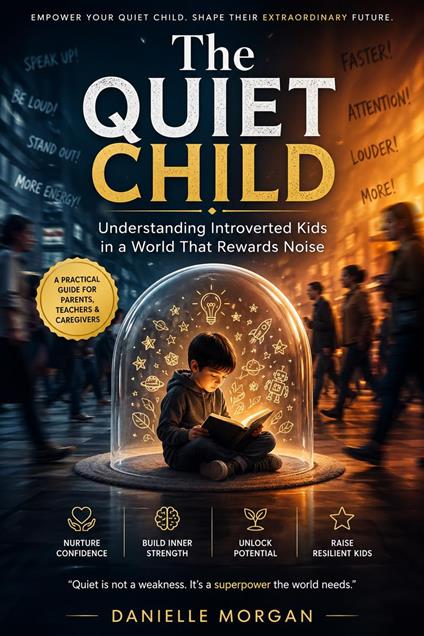
THE QUIET CHILD Understanding Introverted Kids in a World That Rewards Noise What if the child everyone calls "too quiet" is actually listening, observing, imagining, thinking, and feeling more deeply than anyone realizes? In a world that often rewards the loudest voice, the fastest answer, and the child who effortlessly steps into the spotlight, quiet children can easily be misunderstood. They may be labelled shy, withdrawn, timid, antisocial, or lacking confidence. They may constantly hear, "Speak up," "Be more outgoing," or "Why are you so quiet?" But being quiet is not necessarily a problem that needs to be fixed. The Quiet Child is a compassionate and practical guide for parents, teachers, and caregivers who want to understand quiet and introverted children rather than constantly trying to change them. Behind a quiet child may be a world filled with imagination, creativity, sensitivity, curiosity, intelligence, reflection, and enormous potential. Sometimes the child does have something to say. The problem is that the world has become so accustomed to noise that it has forgotten how to listen. A Different Way of Seeing the Quiet Child This book explores what it can mean to grow up as an introverted or naturally reserved child in a society that frequently celebrates extroversion. Being quiet does not automatically mean being weak, unhappy, incapable, or socially deficient. Some children prefer smaller groups to crowds, thoughtful conversations to constant chatter, observation before participation, or solitude after a socially demanding day. Instead of asking, "How do I make this child less quiet?" The Quiet Child encourages adults to ask: "How do I understand this child well enough to help them flourish?" That change in perspective can transform the way adults communicate with children, respond to their behavior, and support their development. For Parents Who Wonder, "Is My Child Okay?" Perhaps your child comes home from school and tells you almost nothing. Maybe they rarely volunteer answers in class, even when you know they understand the lesson. Perhaps they avoid crowded situations, prefer one or two close friends, or need time alone after being around people. You may wonder whether they lack confidence or whether you should push them harder. This book offers a thoughtful framework for understanding these behaviors without reducing your child to a label. For Teachers Who Want to Reach the Child Who Rarely Raises a Hand Classrooms can unintentionally reward children who speak quickly, participate loudly, and place themselves at the center of attention. But participation does not look the same for every child. Some children need more time to process a question. Others communicate more comfortably in smaller settings or demonstrate understanding through writing, creativity, observation, or carefully considered responses. The Quiet Child encourages educators to recognize these differences and create environments where quieter children can participate without feeling that their personality is a problem. Children need adults who can distinguish between supporting growth and demanding conformity. Confidence does not always mean standing in front of a crowd. Sometimes confidence is asking a question, making one friend, sharing an idea after taking time to think, setting a boundary, or simply knowing that you do not have to become someone else to deserve respect. Inside This Book The Quiet Child explores the experiences of introverted and naturally reserved children from a practical and compassionate perspective. It examines how adults can understand their behavior, nurture confidence, support communication, strengthen social development, and create environments where their abilities can emerge.
Leggi di più
Leggi di meno
Autore:
Anno edizione:
2026
Editore:
Formato:
Lingua:
Inglese
Compatibilità:
Tutti i dispositivi (eccetto Kindle) Scopri di più
Layout:
Reflowable
EAN:
9798237980448
L'articolo è stato aggiunto al carrello
Formato:
Gli eBook venduti da IBS.it sono in formato ePub e possono essere protetti da Adobe DRM. In caso di download di un file protetto da DRM si otterrà un file in formato .acs, (Adobe Content Server Message), che dovrà essere aperto tramite Adobe Digital Editions e autorizzato tramite un account Adobe, prima di poter essere letto su pc o trasferito su dispositivi compatibili.
Cloud:
Gli eBook venduti da IBS.it sono sincronizzati automaticamente su tutti i client di lettura Kobo successivamente all’acquisto. Grazie al Cloud Kobo i progressi di lettura, le note, le evidenziazioni vengono salvati e sincronizzati automaticamente su tutti i dispositivi e le APP di lettura Kobo utilizzati per la lettura.
Clicca qui per sapere come scaricare gli ebook utilizzando un pc con sistema operativo Windows
L’articolo è stato aggiunto alla lista dei desideri
