

L’articolo è stato aggiunto alla lista dei desideri










LIBRO INGLESE
 E-mail
 Facebook
 LinkedIn
 Twitter
 WhatsApp
Solution of Crack Problems: The Distributed Dislocation Technique
(0)
Cliccando su “Conferma” dichiari che il contenuto da te inserito è conforme alle Condizioni Generali d’Uso del Sito ed alle Linee Guida sui Contenuti Vietati. Puoi rileggere e modificare e successivamente confermare il tuo contenuto. Tra poche ore lo troverai online (in caso contrario verifica la conformità del contenuto alle policy del Sito).
Grazie per la tua recensione!
Tra poche ore la vedrai online (in caso contrario verifica la conformità del testo alle nostre linee guida). Dopo la pubblicazione per te +4 punti 
207,00 €
+2070
punti 
Venditore: IBS
Articolo acquistabile con Carta del Docente

Articolo acquistabile con Carta Cultura Giovani e Carta del Merito

Paga con Klarna in 3 rate senza interessi per ordini superiori a 39 €

Dati e Statistiche
 Salvato in 0 liste dei desideri
Salvato in 0 liste dei desideri
Solution of Crack Problems: The Distributed Dislocation Technique
Disponibilità in 2 settimane
207,00 €
207,00 €
Disponibilità in 2 settimane
Altre offerte vendute e spedite dai nostri venditori
Libri in Inglese
Solution of Crack Problems: The Distributed Dislocation Technique
Altri venditori
Prezzo e spese di spedizione
Nuovo
 disponibilità in 2 settimane
 Venduto e spedito da
IBS
Venduto e spedito da
IBS
disponibilità in 2 settimane
Spedizione Gratis
207,00 €
Altri venditori
Prezzo e spese di spedizione
Nuovo
disponibilità in 2 settimane
Venduto e spedito da
IBS
disponibilità in 2 settimane
Spedizione Gratis
207,00 €
Altri venditori
Prezzo e spese di spedizione

Tutti i formati ed edizioni

Promo attive (0)
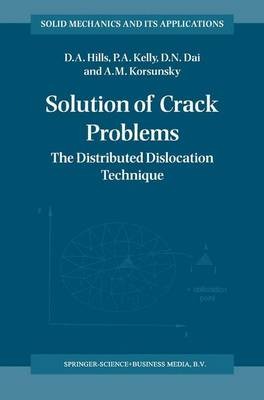
This book is concerned with the numerical solution of crack problems. The techniques to be developed are particularly appropriate when cracks are relatively short, and are growing in the neighbourhood of some stress raising feature, causing a relatively steep stress gradient. It is therefore practicable to represent the geometry in an idealised way, so that a precise solution may be obtained. This contrasts with, say, the finite element method in which the geometry is modelled exactly, but the subsequent solution is approximate, and computationally more taxing. The family of techniques presented in this book, based loosely on the pioneering work of Eshelby in the late 1950's, and developed by Erdogan, Keer, Mura and many others cited in the text, present an attractive alternative. The basic idea is to use the superposition of the stress field present in the unfiawed body, together with an unknown distribution of 'strain nuclei' (in this book, the strain nucleus employed is the dislocation), chosen so that the crack faces become traction-free. The solution used for the stress field for the nucleus is chosen so that other boundary conditions are satisfied. The technique is therefore efficient, and may be used to model the evolution of a developing crack in two or three dimensions. Solution techniques are described in some detail, and the book should be readily accessible to most engineers, whilst preserving the rigour demanded by the researcher who wishes to develop the method itself.
Leggi di più
Leggi di meno
Autore:
Editore:
Collana:
Solid Mechanics and Its Applications
Anno:
1996
Rilegatura:
Hardback
Pagine:
308 p.
Testo in English
Dimensioni:
234 x 156 mm
EAN:
9780792338482
L'articolo è stato aggiunto al carrello
Informazioni e Contatti sulla Sicurezza dei Prodotti
Le schede prodotto sono aggiornate in conformità al Regolamento UE 988/2023. Laddove ci fossero taluni dati non disponibili per ragioni indipendenti da IBS, vi informiamo che stiamo compiendo ogni ragionevole sforzo per inserirli. Vi invitiamo a controllare periodicamente il sito www.ibs.it per eventuali novità e aggiornamenti.
Per le vendite di prodotti da terze parti, ciascun venditore si assume la piena e diretta responsabilità per la commercializzazione del prodotto e per la sua conformità al Regolamento UE 988/2023, nonché alle normative nazionali ed europee vigenti.
Per informazioni sulla sicurezza dei prodotti, contattare productsafetyibs@feltrinelli.it
L’articolo è stato aggiunto alla lista dei desideri
