

L’articolo è stato aggiunto alla lista dei desideri


EBOOK IN LINGUA STRANIERA
 E-mail
 Facebook
 LinkedIn
 Twitter
 WhatsApp
The Tablets & Truth Collection
(0)
Cliccando su “Conferma” dichiari che il contenuto da te inserito è conforme alle Condizioni Generali d’Uso del Sito ed alle Linee Guida sui Contenuti Vietati. Puoi rileggere e modificare e successivamente confermare il tuo contenuto. Tra poche ore lo troverai online (in caso contrario verifica la conformità del contenuto alle policy del Sito).
Grazie per la tua recensione!
Tra poche ore la vedrai online (in caso contrario verifica la conformità del testo alle nostre linee guida). Dopo la pubblicazione per te +4 punti 
8,99 €

Venditore: IBS

Acquista online
Scaricabile subito
Articolo acquistabile con Carta del Docente

Articolo acquistabile con Carta Cultura Giovani e Carta del Merito

Articolo acquistabile con Carta della Cultura

Abbonati a Kobo plus per avere accesso illimitato a questo contenuto

Dati e Statistiche
 Salvato in 0 liste dei desideri
The Tablets & Truth Collection
Scaricabile subito
8,99 €
8,99 €
Scaricabile subito
Altre offerte vendute e spedite dai nostri venditori
Ebook in lingua straniera
The Tablets & Truth Collection
Altri venditori
Prezzo e spese di spedizione

EBOOK INGLESE
EPUB3 con DRMFREE
Scaricabile subito

Venduto e spedito da
IBS
Spedizione Gratis
8,99 €
Altri venditori
Prezzo e spese di spedizione
EBOOK INGLESE
EPUB3 con DRMFREE
Scaricabile subito
Venduto e spedito da
IBS
Spedizione Gratis
8,99 €
Altri venditori
Prezzo e spese di spedizione

Tutti i formati ed edizioni
Promo attive (0)
The Tablets & Truth Collection
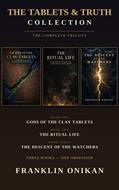
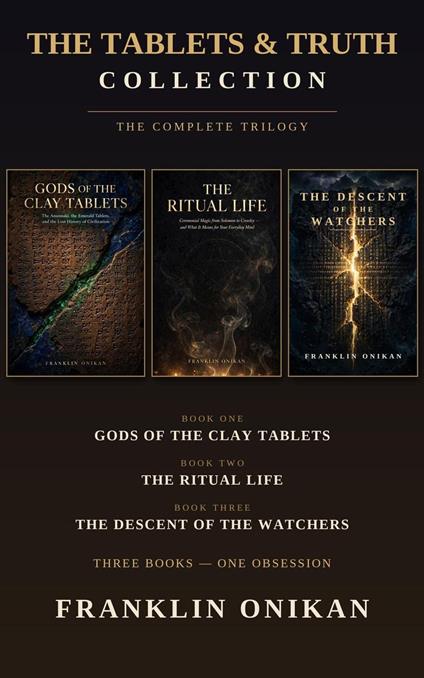
Three books, one obsession — the evidence (Gods of the Clay Tablets), the practice (The Ritual Life), and the story (The Descent of the Watchers). Two sets of tablets. One real. One maybe-mythical. Both built empires of belief. The first set sits in museum drawers in London, Paris, and Baghdad: hundreds of thousands of pieces of baked river clay pressed with wedge-shaped marks — the cuneiform tablets of ancient Mesopotamia, humanity's oldest writing. They hold the oldest laws, the oldest love songs, the oldest flood story, and gods with names we still argue about: the Anunnaki. The second set may never have existed at all: tablets of solid emerald, said to be inscribed by a god-king of Atlantis and revealed in the 1930s to a former cab driver from Oklahoma. Millions have read about them. No scholar has ever held one. For a century, writers have blurred the two together — mixing the real clay of Sumer with the maybe-mythical emerald of Atlantis, the scholarship of Assyriologists with the ancient-astronaut theories of Zecharia Sitchin. Gods of the Clay Tablets unblurs them: the real history of the Anunnaki, the true story of the Emerald Tablet (and Newton's secret obsession with it), the strange case of Maurice Doreal's Atlantean tablets, the Sitchin phenomenon and the scholars' rebuttal, and the Watchers of the Book of Enoch. Written for curious readers who want both the wonder and the evidence — with a clear honesty contract: you'll always know where the evidence ends and the speculation begins. Five hundred years of ceremonial magic — the grimoires, the secret orders, the most notorious magician of the modern age — and what it all means for your everyday mind. It starts with books that claim to command spirits: medieval grimoires copied by candlelight, promising power to anyone who followed their instructions exactly. It runs through John Dee, the astrologer who tried to talk to angels for Queen Elizabeth I; the Victorian gentlemen of the Golden Dawn, grading each other from Neophyte to Adept in a London townhouse; and Aleister Crowley — poet, mountaineer, provocateur — who took their system apart and rebuilt it as a philosophy of human will. The Ritual Life tells this story straight: the real history, the practitioners' claims presented as their claims, and the honest skeptical readings alongside. Then it asks the question most books about magic never ask: why does ritual work on the human mind even if the magic isn't real? Drawing on real research — the psychology of attention, habit, and intention — the final section turns five centuries of magical practice into a practical toolkit for ordinary days. No belief required, no robes necessary, nothing to join. For the curious: readers of history, psychology, and the esoteric who want the wonder and the evidence. Seven hundred feet beneath the Black Sea, linguist Elara Vance finds the impossible: a wall of carved basalt covered in a language that rearranges itself as she reads it. It has been waiting for a reader. For seventy generations. The two hundred Watchers of ancient scripture were never chained beneath the earth. They were encoded — written into the non-coding DNA of humanity itself. And the Seal that has held them for two thousand years is failing. Now the signal is rising out of the blood of children on five continents. A weaponsmith walks the earth wearing a dead man's face. And Elara's eight-year-old nephew — the first child born with no Seal at all — is the one vessel they have been waiting for. The flare is the first key. Consent is the second lock. And no one can be taken. Only given.
Leggi di più
Leggi di meno
Autore:
Anno edizione:
2026
Editore:
Formato:
Lingua:
Inglese
Compatibilità:
Tutti i dispositivi (eccetto Kindle) Scopri di più
Layout:
Reflowable
EAN:
9798237426694
L'articolo è stato aggiunto al carrello
Formato:
Gli eBook venduti da IBS.it sono in formato ePub e possono essere protetti da Adobe DRM. In caso di download di un file protetto da DRM si otterrà un file in formato .acs, (Adobe Content Server Message), che dovrà essere aperto tramite Adobe Digital Editions e autorizzato tramite un account Adobe, prima di poter essere letto su pc o trasferito su dispositivi compatibili.
Cloud:
Gli eBook venduti da IBS.it sono sincronizzati automaticamente su tutti i client di lettura Kobo successivamente all’acquisto. Grazie al Cloud Kobo i progressi di lettura, le note, le evidenziazioni vengono salvati e sincronizzati automaticamente su tutti i dispositivi e le APP di lettura Kobo utilizzati per la lettura.
Clicca qui per sapere come scaricare gli ebook utilizzando un pc con sistema operativo Windows
L’articolo è stato aggiunto alla lista dei desideri
